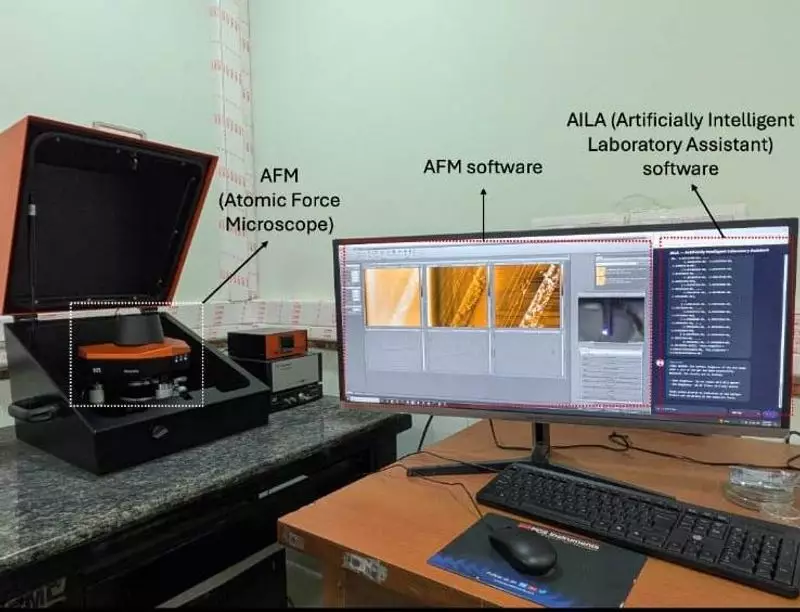
In a significant leap for artificial intelligence and scientific automation, researchers at the Indian Institute of Technology Delhi (IIT Delhi) have developed an AI-powered agent capable of conducting laboratory experiments on its own. This autonomous system, named AILA (Artificial Intelligence Lab Assistant), marks a pioneering step in India's journey towards integrating advanced AI with hands-on scientific research.
The Birth of AILA: An AI That 'Does' Science
The groundbreaking project was spearheaded by a dedicated team from IIT Delhi's Department of Physics, led by Professor Narendra M. Dixit and his PhD student, Maitreyo N. Biswas. Their work, recently published in the prestigious Nature Communications journal, demonstrates how AI can move beyond data analysis and simulation to actively perform physical tasks in a real-world lab setting.
AILA is not merely a software program; it is an integrated system combining artificial intelligence with robotic hardware. The core of its intelligence is a sophisticated Large Language Model (LLM), similar to the technology behind popular chatbots. This LLM is trained to understand complex experimental goals and procedural instructions. Crucially, it then translates this understanding into a series of precise, physical actions executed by a robotic arm.

How the Autonomous AI Lab Assistant Operates
The operation of AILA showcases a seamless blend of planning, perception, and physical execution. The process begins when a researcher provides a high-level instruction, such as "measure the viscosity of this liquid." AILA's AI brain then springs into action, breaking down this goal into a step-by-step experimental protocol.
Using its integrated camera for vision, the system identifies the necessary equipment—beakers, pipettes, or sensors—on the lab bench. The robotic arm, guided by the AI, then physically manipulates these tools. It can pick up items, pour liquids, stir mixtures, operate instruments, and record measurements. Throughout the experiment, AILA continuously monitors the process, makes adjustments based on real-time data, and logs all outcomes meticulously.
The team successfully validated AILA's capabilities by having it autonomously perform a classic physics experiment: determining the viscosity of a liquid. This experiment requires careful handling of materials and precise measurements, tasks that AILA accomplished without human intervention, yielding accurate and reliable results.
Implications and Future of AI-Driven Research
The development of AILA opens up a new frontier for scientific laboratories, both in academia and industry. Its potential applications and impacts are vast and transformative.
Firstly, it promises to dramatically accelerate the pace of scientific discovery. By taking over repetitive, time-consuming, and often tedious experimental procedures, AILA frees up human researchers to focus on higher-level tasks like conceptualizing problems, designing new studies, and interpreting complex results. This could lead to faster breakthroughs in fields ranging from material science and drug discovery to chemistry and biotechnology.
Secondly, it enhances safety and precision. The AI agent can be deployed to conduct experiments involving hazardous materials, extreme temperatures, or sterile environments, minimizing risk to human researchers. Its robotic precision also reduces human error, leading to more reproducible and trustworthy data.
Thirdly, it has profound implications for education. AILA can serve as a 24/7 virtual lab partner for students, allowing them to design and run experiments remotely, especially valuable in scenarios with limited physical lab access or expensive equipment.
Professor Dixit and his team are now focused on scaling AILA's capabilities. Their future roadmap includes enabling the AI to learn from its own experimental outcomes, design follow-up experiments to test new hypotheses, and collaborate with multiple other AI agents on complex, multi-step research projects.

The creation of AILA at IIT Delhi firmly positions India at the forefront of the global movement towards autonomous scientific research. It is a powerful testament to how artificial intelligence is evolving from a tool for computation into an active participant in the empirical process of discovery, potentially reshaping the very nature of scientific work in the years to come.