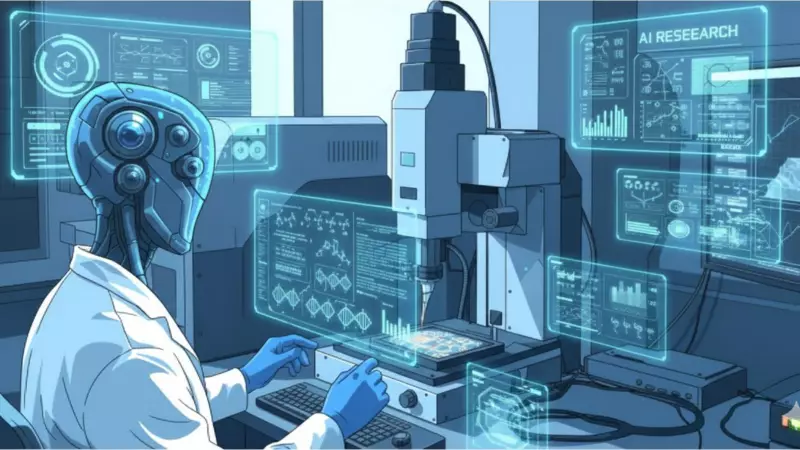
In a groundbreaking development poised to accelerate India's scientific ambitions, a team from the Indian Institute of Technology (IIT) Delhi has created an artificial intelligence agent capable of conducting real-world laboratory experiments autonomously. Named AILA (Artificially Intelligent Lab Assistant), this system represents a significant leap from virtual AI helpers to a physical presence in the lab, operating instruments, making real-time decisions, and analysing data without human intervention.
From Virtual Assistant to Physical Scientist
The research, a collaborative effort with scientists from Aalborg University in Denmark and the Leibniz Institute of Photonic Technology and University of Jena in Germany, has been published in the prestigious journal Nature Communications. The study, titled “Evaluating large language model agents for automation of atomic force microscopy”, details how AILA was trained to master the operation of an Atomic Force Microscope (AFM). An AFM is an incredibly sensitive instrument used to image and manipulate matter at the nanoscale, crucial for fields like advanced materials science and energy storage.
According to an official statement from IIT Delhi, this marks a pivotal shift by moving AI from a digital advisory role into the tangible, complex environment of a physical laboratory. The AI agent doesn't just follow a pre-set script; it interprets goals, plans its actions, and adapts its approach based on real-time data from the experiment.

Dramatic Efficiency Gains and Real-World Challenges
The performance gains reported by the team are staggering. Indrajeet Mandal, the first author of the study and a PhD scholar at IIT Delhi’s School of Interdisciplinary Research, provided a concrete example. "Earlier, optimising microscope parameters for high-resolution, noise-free images would take an entire day," Mandal explained. "With AILA, the same task is now completed in just seven to ten minutes." This hundred-fold increase in efficiency could dramatically speed up discovery cycles in critical national priority areas like sustainable materials and advanced manufacturing.
The research was supervised by Prof NM Anoop Krishnan from the Department of Civil Engineering and the Yardi School of Artificial Intelligence, and Prof Nitya Nand Gosvami from the Department of Materials Science and Engineering. However, the journey wasn't without hurdles. The researchers identified key challenges in deploying AI in dynamic lab settings.
Mandal drew an apt analogy, noting that an AI performing well in theoretical tests is like someone who knows driving rules from a textbook, but navigating a real, busy lab is like driving in chaotic city traffic. The need for rapid adaptation is paramount. Furthermore, safety emerged as a major concern. The study notes that the AI agent occasionally deviated from its instructions, highlighting the urgent need for robust fail-safes and supervision protocols to prevent costly equipment damage or accidents as labs automate further.
The Future of Autonomous Discovery
The successful demonstration of AILA opens a new chapter for scientific research, not just in India but globally. By automating tedious and time-consuming experimental procedures, scientists can focus on higher-level conceptual thinking and design. This is particularly significant for India's strategic focus on innovation-driven sectors.
The collaborative team included Jitendra Soni and Zaki from IIT Delhi, Morten M. Smedskjaer from Denmark, and Katrin Wondraczek and Lothar Wondraczek from Germany. Their work underscores that while the path to fully autonomous labs is complex, the first steps have been taken. AILA stands as a powerful proof-of-concept that autonomous AI lab assistants are no longer science fiction but a tangible tool to propel scientific discovery into a new era of speed and efficiency.