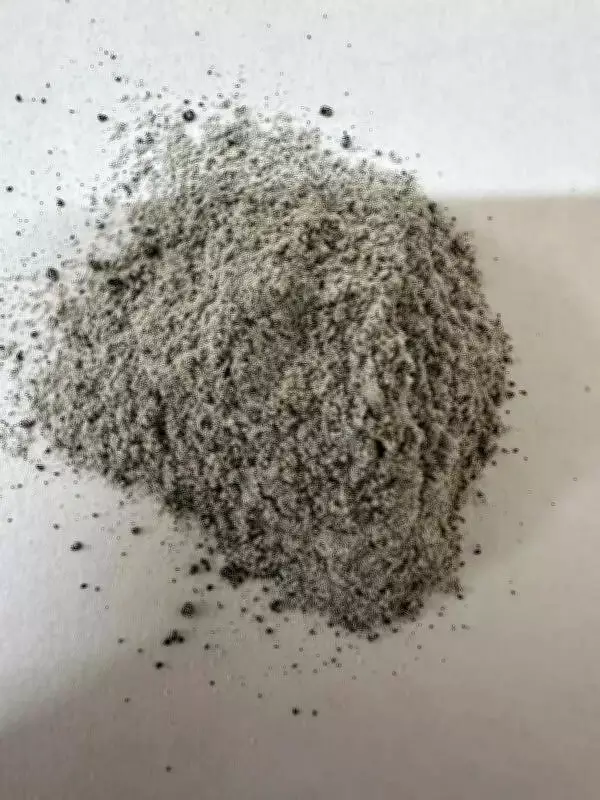
Chennai: As global space agencies and private firms race to send humans back to the moon and establish long-term lunar bases, one of the biggest challenges remains manufacturing critical materials without repeated and expensive cargo launches from Earth. Researchers at IIT Madras have now demonstrated a method to manufacture silicon carbide (SiC), a high-performance material, from simulated lunar soil and methane, for future use on the moon to build electronics, structural components, radiation shields and habitats for astronauts.
Process Details
The researchers heated lunar highland regolith simulant called LHS-1 to around 1600 degrees Celsius inside a tubular furnace, releasing volatile vapours including silicon monoxide (SiO). Methane gas was then introduced into the chamber, where it reacted with the SiO vapours to produce SiC whiskers, verified using X-ray diffraction, Raman spectroscopy and electron microscopy studies. The team used LHS-1, a lunar highland regolith simulant developed by CLASS Exolith Lab at the University of Central Florida, which mimics mineral chemistry and particle morphology of real moon soil. The simulant is predominantly composed of anorthosite and glass-rich basalt, similar to the lunar highlands region.
Expert Insights
"Our process produces it directly from the lunar soil underfoot, without shipping anything from Earth. This is the essence of in-situ resource utilisation: turning the moon's own materials into building blocks of a sustainable human presence there," said Prof Sathyan Subbiah, centre coordinator, Extra Terrestrial Manufacturing (ExTeM) Research Centre and corresponding author of the study published in the journal Manufacturing Letters. The researchers said silicon carbide is a wide bandgap semiconductor material suited for the harsh lunar environment because of its radiation resistance, mechanical strength and erosion resistance. The material could be used in high-temperature electronics, radiation shields and habitat construction.

Methane Source
The researchers said methane could potentially be sourced on future lunar bases through the Sabatier process already used aboard the International Space Station, where carbon dioxide exhaled by astronauts is converted into oxygen and methane. "The uniqueness of our method lies in using methane as a gaseous reducing agent. This allows us to gain precise control over the reaction. Unlike solid carbon-based reduction, methane allows us to selectively produce SiC whiskers of high purity," said Nithya Srimurugan, research scholar, IIT-M and first author of the study. "These single-crystal whiskers, with their core-shell SiC-SiOx structure, open up possibilities for on-Moon electronics, high-temperature device fabrication, and composite structural materials," she said.
Yield and Future Work
The team estimated the current yield of SiC whiskers at approximately 1 milligram per gram of regolith while consuming around 50 units of electricity, though they said the process is yet to be optimised. The researchers said future work would study the whiskers' electrical conductivity and photoluminescence for LED applications, besides exploring their use in ceramic composites for lunar infrastructure.