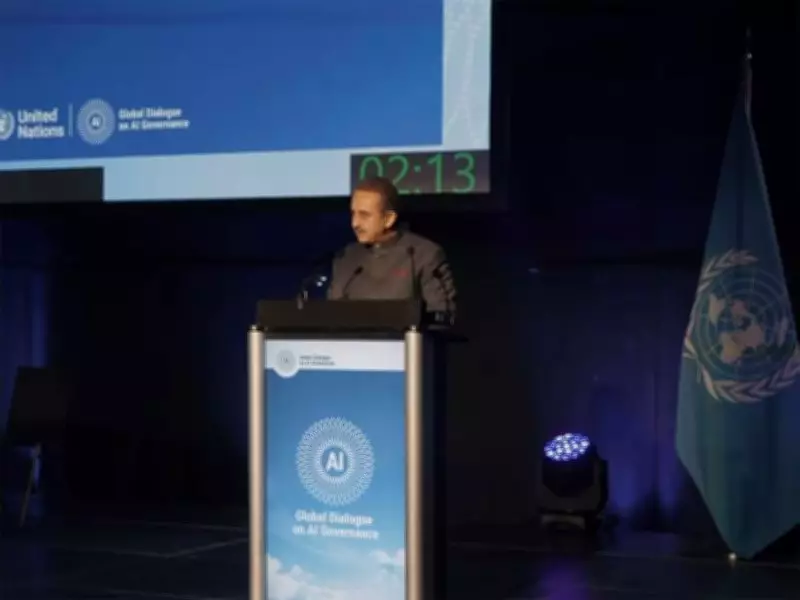
India's Minister of State for External Affairs and Environment, Forest & Climate Change Kirti Vardhan Singh called for responsible, secure, and inclusive global governance of Artificial Intelligence (AI) while addressing the United Nations Global Dialogue on AI Governance in Geneva on July 7, 2026.
Core Principles for AI Governance
Addressing the gathering, Singh stated, "India firmly believes that responsible AI governance must rest on strong foundational principles: preserving human oversight, upholding human rights, and preventing its misuse." He noted that these principles, reflected in the recent India AI Impact Summit, are essential to ensuring that AI systems operate across borders in an ethical, secure, and beneficial manner.
India's 'AI for All' Approach
Highlighting India's approach to AI, Singh said, "Our National Strategy for AI and National AI Governance Guidelines embody the philosophy of 'AI for All'—inclusive growth for everyone without stifling innovation." He stressed that developing countries need greater support to participate meaningfully in shaping global AI rules.

"For the Global South to participate meaningfully in AI governance, we must first close the glaring capacity gaps that exist today," he emphasized.
Multilateral Cooperation and UN's Role
Emphasizing the importance of multilateral cooperation, the Minister said the United Nations is the appropriate platform for forging consensus on AI governance. "Machines do not quarrel over borders, ideology, or pride; humans do. AI governance structure must reflect unity of purpose, and our divisions should not allow technology to outrun diplomacy," Singh said.
Calling the Global Dialogue a defining moment, he said, "This Global Dialogue is not merely a forum; it is a deciding forum. Let this be the moment for us to choose consensus over conflict, before the choice is no longer ours to make."
Potential Impact of AI Decisions
He warned that decisions taken by governments, international organizations, and the private sector in the coming years would determine whether AI becomes "an enabler of equitable progress or a multiplier of existing inequalities." Reaffirming India's commitment, Singh said, "India remains committed to shaping an AI future that is safe, secure, trustworthy, and inclusive."
India's Delegation and UN Dialogue Background
According to the Ministry of External Affairs (MEA), Singh led the Indian delegation to Geneva on July 6-7 to participate in the inaugural UN Global Dialogue on AI Governance. The Global Dialogue on AI Governance is a universal, multi-stakeholder United Nations forum established under UN General Assembly Resolution 79/325 following the adoption of the Global Digital Compact as part of the Pact of the Future in September 2024.
The MEA said the Dialogue aims to advance international AI governance by complementing global, regional, national, and multi-stakeholder initiatives. It also serves as a platform to build capacities, particularly in developing countries, while promoting scientific understanding, transparency, accountability, and robust human oversight of AI systems.
Topics Discussed at the Meeting
The Geneva meeting also received the annual report of the Independent International Scientific Panel on AI and included discussions on AI's social and economic implications, bridging AI divides, safe and trustworthy AI, and human rights in the context of AI.