

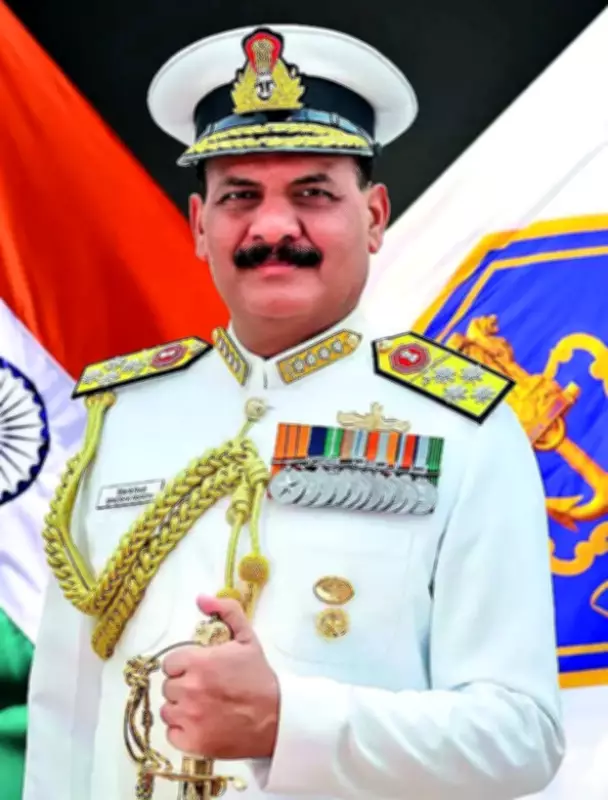
In an exclusive interview on the eve of his retirement, outgoing Indian Navy Chief Admiral Dinesh Kumar Tripathi shared insights on key strategic issues, including the upcoming submarine deal with Germany, the Navy's role in Operation Sindoor, and the path to full indigenisation by 2047.
Submarine Deal with Germany
Admiral Tripathi confirmed that the Project 75(I) deal for six next-generation conventional submarines with Air Independent Propulsion is progressing. The contract, with Mazagon Dock Shipbuilders Limited as the strategic partner and ThyssenKrupp Marine Systems of Germany as the original equipment manufacturer, is expected to be concluded in a few months. The first submarine is slated for induction in 2033, with one submarine commissioned each year until 2038.
The Admiral emphasised that the deal is not just about acquiring submarines but about deepening national capability through complete technology transfer and design transfer under the Strategic Partnership Model. This step is critical for building India's indigenous submarine design and manufacturing ecosystem, ultimately achieving self-reliance.

Indigenisation and Self-Reliance
On the Navy's progress under the Aatmanirbhar initiative, Admiral Tripathi noted that all 45 ships currently under construction are being built in Indian shipyards. The indigenous content in recently commissioned warships is around 80%, with 90% in the Float segment, 60% in the Move segment, and 50% in the Fight segment. However, he stressed that indigenisation is not just about percentages but about creating sovereign capability and technological depth.
He outlined the goal of achieving 100% indigenous content by 2047, with ongoing research and development projects involving 25 DRDO labs. The Navy is focusing on deep component and sub-component levels to reduce external dependencies.
Operation Sindoor and Naval Deterrence
Reflecting on Operation Sindoor, Admiral Tripathi stated that the Navy's forward deployment of a Carrier Battle Group in the Northern Arabian Sea forced the Pakistan Navy to remain confined to its ports. This constrained the adversary's options and delivered a blow to Pakistan's economy, as global shipping companies avoided their ports due to increased risks and insurance premiums.
He affirmed that the Navy remains ready for decisive action in any future conflict, with sea-based power providing reach, flexibility, and escalation control. The Navy maintains readiness for kinetic action across the spectrum, from presence and surveillance to deterrence and offensive operations.
Securing Maritime Trade Routes
On securing India-bound oil tankers and maritime trade routes, particularly in the Gulf region, Admiral Tripathi outlined a comprehensive framework based on sustained operational presence, mission-based deployments, and logistics agreements. The Navy maintains a continuous presence in critical shipping lanes, such as the Gulf of Aden for anti-piracy duties since 2008.
The Information Fusion Centre - Indian Ocean Region has established linkages with partner countries for coordinated operational responses. The Admiral emphasised that maritime security requires collective effort and cooperative frameworks, and India continues to work closely with regional partners through coordinated patrols and logistics partnerships.
Role in the Indian Ocean Region
Addressing China's increasing bases in the Indian Ocean Region, Admiral Tripathi stated that the Indian Navy's efforts are not aimed at dominating the region but at ensuring the security of India's maritime interests and contributing to a stable, free, and open Indo-Pacific. The Navy is augmenting its force levels, aiming to become a 200-plus ship Navy by 2035, and maintaining high operational tempo through mission-based deployments.
He highlighted the importance of regional maritime cooperation under the MAHASAGAR vision, with expanded bilateral and multilateral exercises, logistics agreements, and operational engagements. The IFC-IOR serves as a key platform for information sharing and coordination.

Technological Transformation
Under Admiral Tripathi's command, the Navy has integrated artificial intelligence and quantum technologies. The Indian Navy Incubation Centre for Artificial Intelligence and the CRYSTAL AI Data Centre and Lab in Bengaluru are running around 45 use cases across operations, logistics, and administration. For quantum technologies, the Navy is partnering with Indian deep-tech startups for secure communications and quantum positioning.
The Admiral expects the Navy to remain an adaptive learning organisation, absorbing technology quickly and operationalising it responsibly. He called for continued government support for indigenous research and development, faster procurement pathways, and sustained investment in secure digital and maritime infrastructure.





