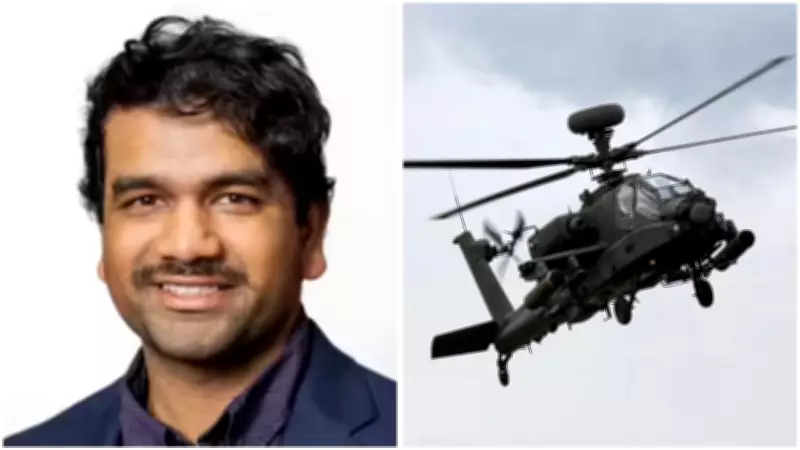
An Indian-American technology executive has come into the spotlight after a drone boat developed by his company was used in what the US military described as its first rescue operation involving an autonomous surface vessel.
Rescue Operation Details
Two crew members of a US Army Apache helicopter that went down near the Strait of Hormuz were rescued by the autonomous vessel Corsair, developed by Texas-based Saronic Technologies. The rescue operation marked the first known instance of the US Armed Forces using an autonomous surface vessel, remotely piloted by a human operator, to recover personnel at sea. The helicopter crashed while operating near the coast of Oman. The crew members were rescued within about two hours and were later reported to be in stable condition.
Who is Vibhav Altekar?
Vibhav Altekar is the co-founder and chief technology officer (CTO) of Texas-based defence technology company Saronic Technologies. He studied electrical engineering at the University of California. Altekar oversees the development of Saronic's autonomous systems and software architecture. According to the company's website, he leads forward deployed engineering, product, special programs and software teams, working across areas such as perception, navigation, machine learning, command and control, and systems integration. According to news agency PTI, he is a perception engineer with expertise in autonomous systems and maritime technology. Before co-founding Saronic, he worked on several US Department of Defence technology programmes. He was among the earliest engineers at defence technology firm Anduril, where he led engineering efforts on multiple projects, including the Royal Australian Navy's Ghost Shark autonomous submarine programme.

About Saronic Technologies and the Corsair
Saronic Technologies was founded in September 2022 by former Navy SEAL Dino Mavrookas along with Altekar, Doug Lambert and Rob Lehman. The company is headquartered in Austin, Texas, and its LinkedIn profile states that it holds a USD 392 million production contract with the US Navy for autonomous surface vessels. The Corsair vessel used in the rescue operation is a 24-foot autonomous surface vessel capable of carrying up to 1,000 pounds and travelling more than 1,000 nautical miles. It can reach speeds of over 35 knots and forms part of the US military's broader effort to integrate autonomous systems into maritime operations. The Strait of Hormuz rescue is being seen as a significant milestone in that effort, demonstrating how autonomous vessels can be used not only for surveillance and reconnaissance but also for real-world rescue missions involving human lives.