

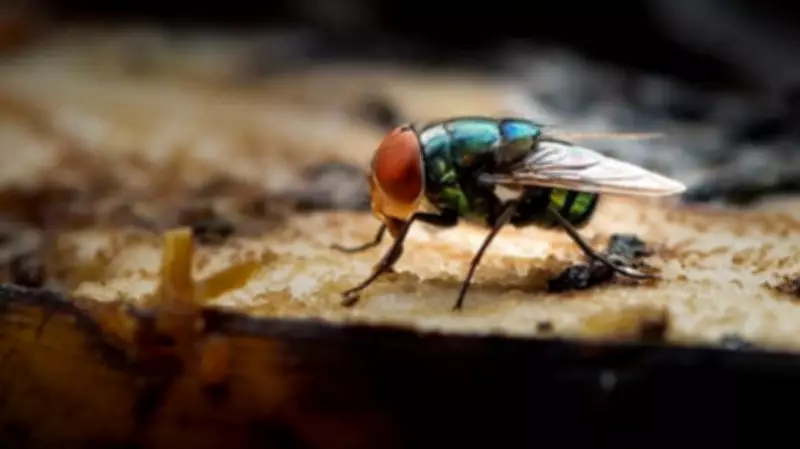
A groundbreaking study into the neural workings of a tiny insect brain has unveiled principles that could revolutionize artificial intelligence (AI) and robotics. Researchers discovered that the insect brain, despite its minuscule size, processes information with remarkable speed and efficiency, offering a blueprint for designing faster and more energy-efficient AI systems.
The Discovery
Scientists at the University of Cambridge and the University of Sheffield examined the brain of the fruit fly (Drosophila melanogaster). They found that the insect's neural circuits are organized in a way that minimizes the number of connections needed for complex computations. This architecture allows the insect to make rapid decisions with limited energy, a trait that has evolved over millions of years.
Key Findings
- Efficient Neural Wiring: The insect brain uses a highly structured network that reduces redundancy, enabling faster signal transmission.
- Low Energy Consumption: Compared to artificial neural networks, the insect brain operates on a fraction of the energy, making it an ideal model for sustainable AI.
- Robust Decision-Making: Despite its simplicity, the insect brain can perform tasks like navigation and object recognition with high accuracy.
Implications for AI and Robotics
The research provides a new approach to building AI systems that are not only faster but also more energy-efficient. Current AI models, particularly deep learning networks, require massive computational power and energy. By mimicking the insect brain's structure, engineers could develop hardware and algorithms that process data locally, reducing reliance on cloud computing and lowering energy costs.

Potential Applications
- Autonomous Drones: Insect-inspired AI could enable drones to navigate complex environments with minimal power.
- Edge Computing: Efficient neural networks could run on small devices, enhancing IoT capabilities.
- Robotics: Robots could make real-time decisions with limited onboard resources, improving autonomy.
Expert Insights
Dr. Lucia Prieto-Godino, lead author of the study, stated: 'The insect brain is a marvel of natural engineering. By understanding its wiring, we can create AI that is not only smarter but also greener.' Co-author Professor James MacInnes added: 'This is a step towards neuromorphic computing, where hardware mimics biological systems for superior performance.'
Future Research
The team plans to map the entire insect brain connectome and test their models on robotic platforms. They hope to commercialize the technology within a decade, potentially transforming industries from healthcare to manufacturing.
This discovery underscores the value of biomimicry in technological innovation. As AI continues to grow, lessons from nature may hold the key to overcoming its biggest challenges: speed, efficiency, and sustainability.






