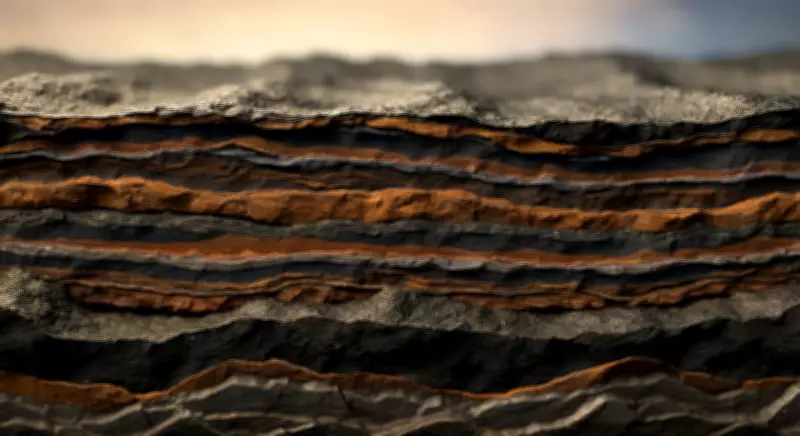
For much of the 20th century, the extinction of the dinosaurs remained a profound mystery with no single explanation. Scientists debated whether gradual climate changes, volcanic activity, shifting sea levels, or other ecological factors caused their demise. However, a pivotal discovery in 1980 transformed the field: an unusually high concentration of iridium found in a thin layer of clay deposits in Italy.
This discovery might seem unremarkable compared to traditional scientific breakthroughs. Initially, no large fossils or crater evidence were found. The key was a thin geological layer in Italy marking the end of the Cretaceous period and the beginning of the Paleogene. As detailed in a groundbreaking study published in Nature, this rock layer contained anomalously high levels of iridium, a rare element on Earth.
The Clue Hidden in Ancient Rock
Walter Alvarez originally aimed to determine the time span represented by the thin boundary layer. This required analyzing trace elements within the clay. From these studies emerged the iridium anomaly, which defied easy explanation. According to the Nature study, iridium is extremely scarce in Earth's crust but relatively abundant in meteorites. The researchers proposed that the enrichment came from material released by a massive extraterrestrial impact. They suggested that debris from such an event would have traveled globally and settled into the thin boundary layer.

This discovery was a major breakthrough for extinction science. Previously, catastrophic asteroid impacts were not considered a likely cause of extinction events, such as the one at the end of the Cretaceous period.
Why Iridium Mattered So Much
The significance of iridium's presence lay in its rarity. The researchers referred not just to any strange rock layer but to a chemical element inconsistent with natural sedimentation processes. According to research archived by the US National Library of Medicine, the iridium anomaly became powerful evidence because it was measurable and testable across different geological sites. Scientists could examine whether similar boundary layers elsewhere carried the same extraterrestrial signature.
As a result, the hypothesis gained rigor, as it could be challenged based on field studies, geochemical tests, and worldwide observations. The most surprising aspect was the contrast between scales: microscopic amounts of an uncommon metal in a thin clay layer suggested a catastrophe of planetary proportions.
The Asteroid Theory Was Not Instantly Accepted
In the early 1980s, the asteroid hypothesis was generally met with skepticism, as numerous theories supported gradual extinction due to volcanic eruptions, climatic changes, or ecological deterioration. According to reports, the asteroid theory faced scrutiny because extinctions had long been examined from the perspective of slow environmental processes rather than abrupt disasters. Although the iridium discovery did not resolve the debate immediately, it shifted the entire discussion. Evidence for an impact continued to mount as researchers found shocked minerals, impact materials, and eventually the Chicxulub crater in present-day Mexico, which is considered key evidence explaining the extinction event.
A Discovery Built Through Stages
This story illustrates that science does not always progress through a single major breakthrough. The 1980 paper set a new direction, but acceptance was slow, building gradually from research across various fields. As researchers explained, the iridium discovery near Gubbio made scientists think differently due to geochemical evidence linked to extinction. Subsequent research built on these findings through charts and modeling.
However, scientists continue to investigate how volcanic eruptions, climate change, and environmental pressures might have contributed to the extinction. Nonetheless, the iridium finding ensured that extinction science could no longer ignore the possibility of a catastrophically sudden cause.

Why the Story Still Resonates
The appeal of the dinosaurs' extinction partly lies in its enormous emotional proportions. The loss of dinosaurs is arguably Earth's most famous extinction story. What turned out to be a great revelation was an extremely minor detail. Interestingly, it was not some enormous fossil skeleton or spectacular scene that made the difference, but the chemistry of clay from millions of years ago. This finding also changed how scientists approach the study of our planet's past. In addition to fossils, geochemical findings became essential for researching Earth's history. An insignificant trace element in rock made all the difference when more obvious sources proved fruitless.
In short, the discovery was not only the reason the dinosaur extinction mystery was solved; it demonstrated that science makes breakthroughs by patiently examining tiny details.