

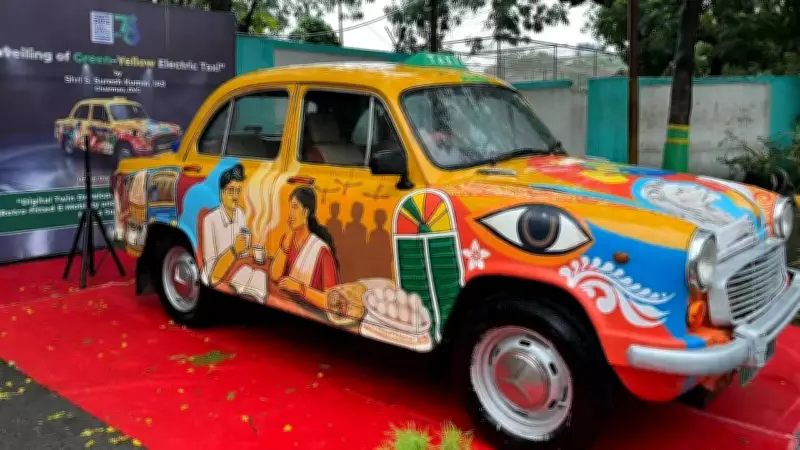
Kolkata: Jadavpur University has unveiled a functional prototype retrofitted electric Ambassador taxi, demonstrating a practical pathway to accelerate India's transition to electric mobility without forcing the premature scrapping of existing Internal Combustion Engine (ICE) vehicles. In a country where millions depend on legacy vehicles for livelihood, the shift to new, custom-built EV platforms can impose significant socio-economic costs and leave owners with little salvage value. The university's initiative addresses this challenge by converting an in-service diesel vehicle into a zero-emission electric vehicle through a technically robust, scalable retrofit approach.
Project Details and Collaboration
The prototype has been developed under the research project titled “Digital Twin Development to study Feasibility of Retro-fitted E-mobility and Technical Requirements for its Sustainability”, undertaken by the Department of Power Engineering at Jadavpur University in collaboration with Damodar Valley Corporation (DVC). The project is funded by DVC's R&D funds and is designed to build evidence, engineering methods, and implementation models that can support sustainable retrofitted e-mobility in Indian operating conditions.
The three-year project, commencing January 2025, is supervised by Prof. Amitava Gupta, professor and former head of the Department of Power Engineering, as Principal Investigator, with faculty support from Bhimsen Tudu and Nirmalendu Biswas. The work focuses on integrating a motor-drive system that replaces the ICE and fuel line with an electric motor, controller, and an intelligent interface capable of adapting to the vehicle's existing transmission and auxiliary systems. A key engineering challenge is achieving EV-grade drivability while retaining a gear-shift mechanism through an automatic shifting and motor-control strategy—an approach distinct from conventional EV architectures that typically require complete transmission replacement, increasing conversion cost.

Prototype Specifications and Testing
As a first target platform, an Ambassador 1.5DZ taxi—iconic on Kolkata streets—was selected. The prototype has been tested in experimental confinement with satisfactory results. It is equipped with sensor systems designed for IoT interfacing to enable optimal controller development, and includes air-conditioning as a standard feature. The expected single-charge serviceable distance is estimated at about 200 km in city conditions, with running costs projected to be comparable to EVs in its segment. A swappable-battery business model has been assumed; battery modules have been designed accordingly, with attention to water-logging risks common in Kolkata and other Indian cities.
Unveiling and Future Plans
The prototype was unveiled on May 29, 2026, by DVC chairman Suresh Kumar in the presence of JU vice-chancellor Chiranjib Bhattacharjee and other dignitaries. The vehicle will now undergo testing, analysis, and modifications required for certification by the Automotive Research Association of India (ARAI).
To translate research into deployment, JU has partnered with M/s P2G Mobility, a Kolkata-based MSME, to develop the first prototype under the university's design guidance. The project team includes four research scholars—two funded by the project and two AICTE doctoral fellows—and provides internship opportunities for Masters and undergraduate students, strengthening hands-on technical education alongside innovation for national priorities.
Expert Insights and Cost Analysis
According to Prof. Amitava Gupta, "By this year-end, we will be ready with a proper product with hi-tech features like Advanced Driver Assistance System (ADAS) that is found in modern vehicles." He further explained that the transition cost of an existing ICE vehicle to EV, inclusive of an automated manual transmission, would be Rs 4-5 lakh, with two swappable batteries costing an additional Rs 2-2.5 lakh. "The car can be available with Battery As A Service, an electric vehicle ownership model that separates the cost of the battery from the vehicle itself. Buyers purchase or finance the vehicle shell at a significantly lower upfront price and instead subscribe to or rent the battery on a monthly or per-kilometer basis," he added.

This initiative by Jadavpur University not only provides a cost-effective solution for retrofitting existing vehicles but also supports the livelihoods of millions who depend on older vehicles, while contributing to India's ambitious electric mobility goals.





