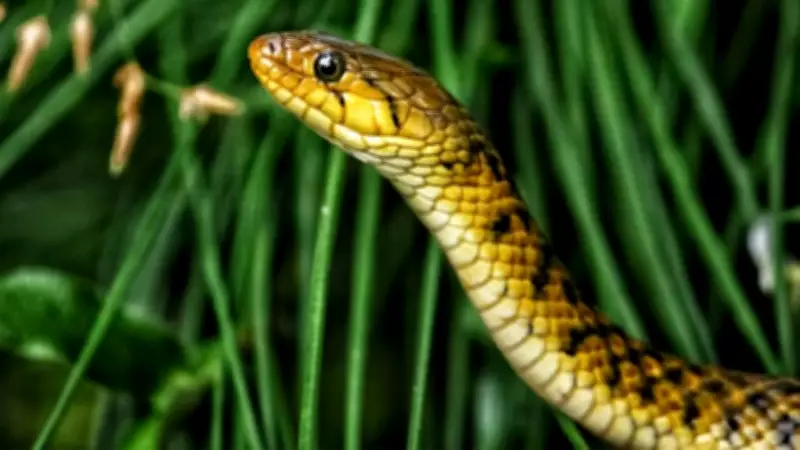
Kerala is renowned for its lush green forests, serene rivers, mist-covered mountains, and vast biodiversity. However, beyond these attractions lies another remarkable aspect of its natural life: the fascinating snake fauna. Due to the state's tropical climate and its location within the Western Ghats, Kerala hosts a wide variety of snake species. While some snakes found in Kerala are non-venomous, such as rat snakes and vine snakes, others are medically significant, including cobras, kraits, and vipers.
Snake Diversity in Kerala
According to research by Springer Nature, there are over 100 types of snakes in Kerala, with nearly 35 being venomous, making it one of India's snake-rich states. The Kerala State Biodiversity Board's Handbook on Snakes of Kerala highlights several key species.
Spectacled Cobra
The spectacled cobra is one of the most common venomous snakes in Kerala. It is easily recognized by the hood it displays when threatened, featuring a spectacle-like pattern. This snake has a yellow, dark brown, or black body and is often found in fields with abundant rodent populations. It rarely attacks and usually avoids human contact, raising its hood as a warning signal.

Common Krait
The common krait is medically significant and identifiable by its glossy, black or bluish-black body with thin white stripes. Being nocturnal, it is often encountered in rural areas during the rainy season when it preys on rats. A krait bite may cause little pain or swelling, leading victims to underestimate the danger.
Russell's Viper
The Russell's viper is a common cause of severe snakebite cases, according to a hospital-based study in North Kerala. It has a stout body with a chain-like pattern of oval dark brown spots. Found in farms, plantations, thorny scrub, and grasslands, it prefers to stay camouflaged and rarely moves when danger is detected, often leading to accidental encounters with workers. Its potent venom requires immediate medical attention.
Hump-nosed Pit Viper
Studies in Kerala identify the hump-nosed pit viper as a significant species responsible for many snakebites, especially near the Western Ghats. Smaller than cobras and Russell's vipers, it has a slightly raised snout, triangular head, and brown or reddish-brown color that blends with dry leaves. Its exceptional camouflage makes it hard to spot for trekkers and plantation workers. Notably, standard antivenom for India's Big Four does not work against it.
Green Vine Snake
The green vine snake is known for its beauty, with a long thin body, sharp nose, and vibrant green color that helps it blend into surroundings. It is commonly found in gardens, jungles, and shrubby areas, preying on lizards, frogs, and small animals. Despite its fearsome appearance, it is only mildly venomous.
Indian Rat Snake
The Indian rat snake is one of the most common species in Kerala and is often mistaken for a cobra due to its large size and habit of lifting its front half when frightened. It has a brownish, olive, gray, or black body and is a quick-moving non-venomous species. Wildlife specialists note that rat snakes are beneficial to farmers as they control rodent populations. Unlike cobras, they cannot form a hood and are harmless.
King Cobra
The king cobra, the largest venomous snake species, is an important reptile in the Western Ghats of Kerala. It features a huge body, slender hood, and olive-green, brown, or black color with pale bands. Encounters with humans are rare as it avoids attack and tries to escape.
Disclaimer: This article is for informational and educational purposes only. Snake identification can be difficult, and many species may appear similar to untrained observers.