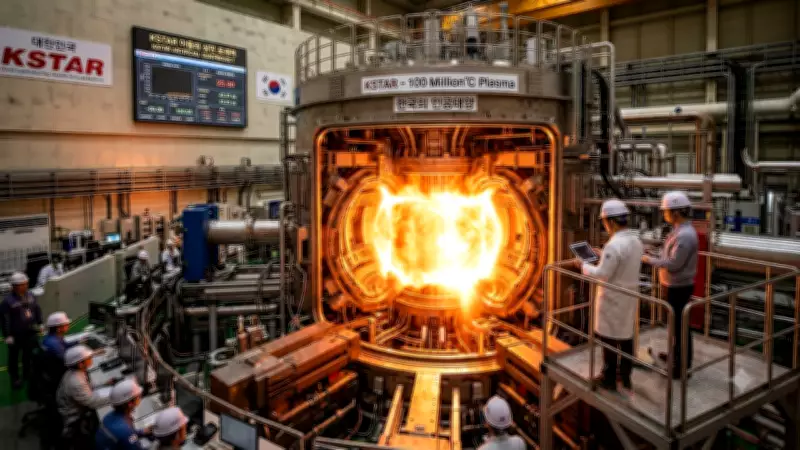
South Korea's KSTAR (Korea Superconducting Tokamak Advanced Research) artificial sun has achieved a significant milestone in nuclear fusion research. The Korea Institute of Fusion Energy (KFE) announced that KSTAR sustained plasma in high-confinement mode (H-mode) for 102 seconds while maintaining a plasma temperature of 100 million degrees Celsius for 48 seconds. This breakthrough brings the world closer to harnessing clean fusion energy, which promises unlimited electricity with minimal carbon emissions.
KSTAR Artificial Sun Sets a New Fusion Record
Nuclear fusion has long been considered the holy grail of energy production. Unlike traditional nuclear fission, which splits atoms to release energy, fusion combines light atomic nuclei to generate massive energy—the same process that powers stars. KSTAR has emerged as one of the leading fusion reactors globally. During the 2023-2024 plasma campaign, scientists achieved a 100 million-degree ion temperature for 48 seconds, preceded by a 102-second H-mode operation, surpassing previous records.
Why 100 Million Degree Plasma is Crucial
Creating fusion on Earth is extremely challenging. The Sun relies on immense gravitational pressure to fuse hydrogen atoms, but on Earth, scientists must compensate with extreme heat. At 100 million degrees Celsius, plasma becomes hot enough for hydrogen isotopes to overcome their repulsion and fuse. However, no known material can withstand such heat without damage. KSTAR uses superconducting magnetic forces to confine plasma in a doughnut-shaped tokamak vessel. Sustaining these conditions for longer periods is vital for advancing fusion research.

Tungsten Divertor Technology Overcomes Key Barriers
A critical factor in KSTAR's success is the newly installed tungsten divertor, located at the bottom of the tokamak. This component withstands extreme heat and exhaust plasma. Previous carbon divertors reached their limits as experiments intensified. Tungsten's exceptional heat resistance allows the reactor to operate at higher temperatures. According to KFE, tungsten provides the conditions needed for future long-pulse plasmas, with a goal of sustaining 100 million degrees for 300 seconds.
The Future of Nuclear Fusion Energy
Despite this progress, fusion scientists remain cautious. Achieving sustained plasma for minutes or hours and producing more energy than consumed remains one of science's greatest engineering challenges. Nevertheless, KSTAR's advancements demonstrate rapid progress in fusion technology. Researchers at the KSTAR Research Center aim to operate for 300 seconds at temperatures exceeding 100 million degrees. Dr. Si-Woo Yoon, director of the center, attributed this success to intensive hardware testing and careful campaign planning. If future research continues, fusion energy could become a carbon-free, virtually limitless power source. KSTAR's 102-second record does not violate physical laws; rather, it shows scientists are learning to operate at the edge of those laws.