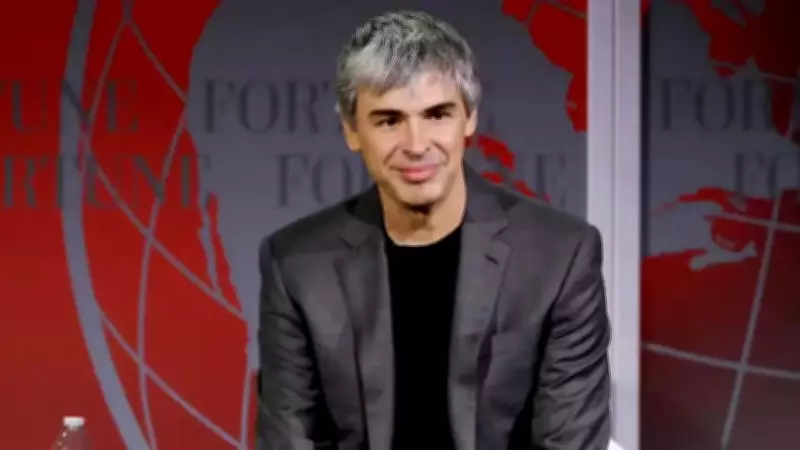
Larry Page's Unconventional Vision: Embracing 'Crazy' for Breakthrough Success
For many corporate executives, achieving a 10% growth margin is a cause for celebration. However, for Larry Page, the co-founder of Google, such modest gains represent a profound failure. In an industry often dominated by cautious strategies and incremental improvements, Page has constructed a global empire based on a bold and audacious philosophy: success demands embracing the 'crazy.'
The CEO's Blunt Assessment on Ambition
In 2013, while serving as CEO after taking over from Eric Schmidt, Page articulated this mindset in an interview with Wired. At that time, Google was deeply engaged in integrating its services, launching significant hardware initiatives, and pivoting toward mobile and social platforms. Key products like Google Glass, Chromecast, and the Nexus 5 smartphone highlighted this era.
Page offered a stark critique of conventional ambition, stating, "If you're not doing some things that are crazy, then you're doing the wrong things." This quote encapsulates his belief that playing it safe leads to mediocrity, whereas pursuing radical ideas can yield extraordinary outcomes.

Rejecting Incrementalism for 10x Improvements
Page's leadership style stood in sharp contrast to many Silicon Valley peers. While competitors often focused on tweaking code or finding hidden efficiencies for small gains, Page challenged his team to develop products and services that were ten times better than anything available. He argued that a mere 10% improvement means you are essentially replicating what others do, which he deemed insufficient.
According to Page, this cautious approach might avoid spectacular failures but also guarantees you will never "succeed wildly." To achieve a 1000% enhancement, he emphasized the need to fundamentally rethink problems, pushing the boundaries of technical possibility.
Google X: A Hub for Moon-Shot Innovations
To institutionalize this philosophy, Page established Google X, a secretive division dedicated to ambitious 'moon-shot' projects such as self-driving cars. When questioned about the necessity of a separate department for these experiments, Page expressed dissatisfaction with Apple's model of focusing on a very small number of products.
He explained, "I find that unsatisfying. I feel like there are all these opportunities in the world to use technology to make people's lives better." Page noted that Google and other tech companies are only addressing a tiny fraction of potential technological advancements, leaving vast untapped territory. He acknowledged investor concerns about spending on 'crazy' ventures but pointed out that past projects like YouTube, Chrome, and Android—once considered risky—are now major successes.
From Academic Roots to Global Impact
Page's disregard for the impossible traces back to his education at the University of Michigan and Stanford University. What began as a simple thesis idea to annotate web pages evolved into Google, a search engine that revolutionized information access. With the financial stability provided by Google's advertising revenue, Page expanded his ambitions further.
- Gmail launched with 100 times more storage than competitors.
- Google Books aimed to digitize nearly every published book.
- Google Fiber offered broadband speeds 100 times faster than industry standards.
Challenges and Criticisms in Modern Innovation
Despite facing regulatory scrutiny and criticism over Google's dominance, Page's philosophy remains a guiding light for optimists. He views innovations like self-driving cars as more valuable contributions to humanity than mere financial metrics. Page also highlighted a critical flaw in contemporary education systems, arguing they fail to train individuals to select projects with broad technological impact, instead promoting narrow specializations.
He remarked, "Our system trains people in specialised ways, but not to pick the right projects to make a broad technological impact." In Page's perspective, the greatest threat to any company is not competition or legal challenges, but a lack of ambition. By championing 'crazy' ideas, he continues to inspire a culture of relentless innovation and transformative thinking.