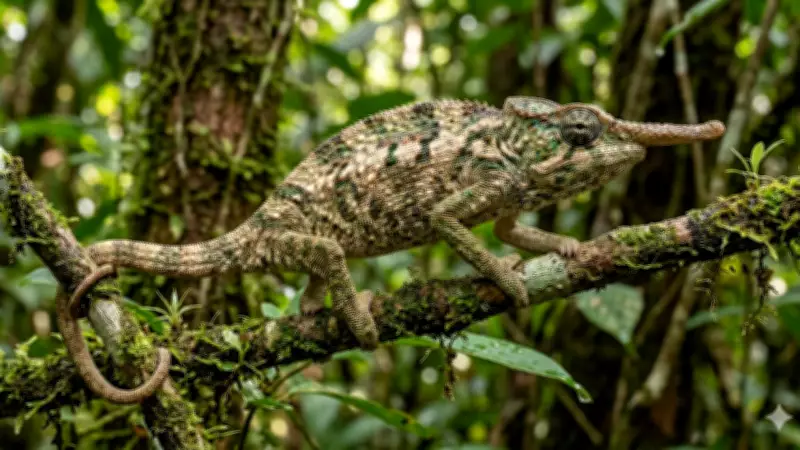
Madagascar's well-known Pinocchio chameleon, famed for its remarkably long nose, has surprised scientists. Genetic studies have revealed that the chameleon was incorrectly identified for nearly 150 years. In their study of the Calumma gallus species complex, scientists discovered that what was believed to be one species of chameleon turned out to be another, named Calumma pinocchio. Using DNA sequencing, morphological analysis, and museomic analysis of museum specimens, researchers uncovered previously unknown chameleon diversity in Madagascar. In addition to identifying the new species, they also found a second new chameleon species.
Madagascar's Long-Nosed Pinocchio Chameleon Turns Out to Be a Hidden Species
Scientists had previously relied heavily on morphology to categorize Madagascar's long-nosed chameleons. The unique nasal appendages in male animals served as a key criterion for determining species within the Calumma gallus complex. At face value, this methodology seemed sensible because some chameleons had long, blade-like noses, while others had short or curved ones. However, new research titled 'Towards a revision of the Malagasy chameleons of the Calumma gallus complex: Redefinition of Calumma nasutum based on a museomics approach and descriptions of two new species' showed that the lizard widely known as the 'Pinocchio chameleon' was actually a different species from what scientists originally thought. According to genetic and morphological studies, the reptile is a new species dubbed Calumma pinocchio.
"Genetic data show clearly that the so-called 'nose chameleons' were able to fool previous research for a long time," said Dr. Frank Glaw of SNSB. The findings were published in Salamandra – German Journal of Herpetology.

How DNA and Museum Specimens Solved the Puzzle
One of the most intriguing aspects of the study was "museomics," an innovative methodology that allows scientists to analyze DNA from ancient museum specimens. Some of the stored chameleons used in the research dated back to 1836. Scientists found that various individuals classified as belonging to the same species were genetically different from each other. Moreover, they revealed the presence of a second cryptic species, Calumma hofreiteri, which had been incorrectly classified as Calumma nasutum due to similarities in snout shape and body build. According to Professor Miguel Vences of the Technical University of Braunschweig, this study "clearly showed the great potential of the new museomics techniques for a correct identification of historically collected specimens within species complexes."
Why the Chameleon's Nose Kept Changing
One reason scientists speculate why it took so long to solve the mystery is that these lizards evolved extremely fast. The research suggests that nasal appendages can change rapidly in morphology, coloration, and dimensions over a relatively short evolutionary period. The researchers hypothesize that female preferences in mate selection could play a key role. Essentially, male chameleons with more attractive or distinctively shaped noses may be more successful at mating, driving rapid diversification among closely related species. "The evolution of these appendices might possibly be driven by the respective preferences of females in mate selection," Dr. Glaw observed. This implies that the signature 'Pinocchio' nose is not just for show but a product of millions of years of evolution.
Why Madagascar Remains a Hotspot for Hidden Species
Madagascar is well-known as one of the world's most biologically distinct countries, hosting over 40 percent of the world's known chameleon species. According to scientists, discoveries like Calumma pinocchio show that there is still much to learn about Madagascar's ecosystem. There could be more undiscovered creatures hiding in remote forests or misidentified within museum collections. Moreover, the research emphasizes the importance of combining traditional methods with innovative techniques. Without genetic sequencing, the existence of the Pinocchio chameleon would likely have gone unnoticed. For researchers, this discovery is a testament to how the natural world continues to conceal its mysteries, even in the most unlikely places.