

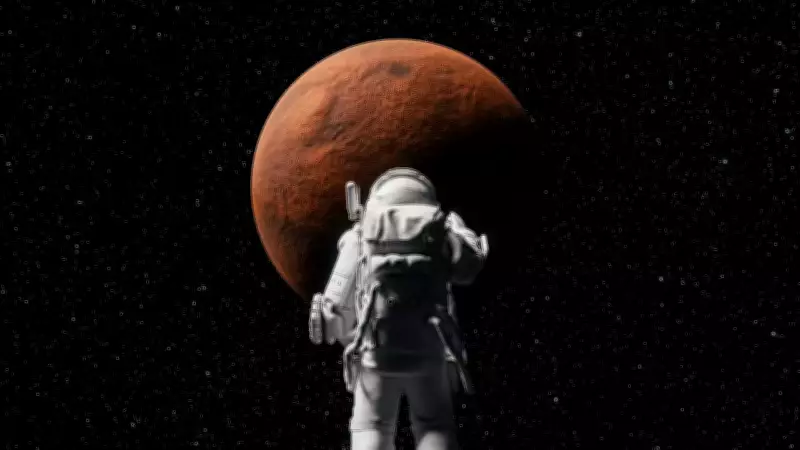
Mars Time Runs Faster Than Earth's: Einstein's Relativity Confirmed in Space
Can Mars make humans age faster? While this sounds like poetic speculation, it holds a kernel of scientific truth. Recent groundbreaking research has confirmed that time itself flows differently on the Red Planet compared to Earth, validating predictions made by Albert Einstein over a century ago.
The Martian Time Differential: A Scientific Reality
Space continues to reveal its strange and counterintuitive nature. A fascinating discovery has emerged: identical clocks placed on Earth and Mars would gradually drift apart over time. According to a study published in ScienceDaily titled 'Time runs faster on Mars and scientists just proved it,' clocks on Mars would run approximately 477 microseconds faster per Earth day than their terrestrial counterparts.
While this difference amounts to less than a thousandth of a second daily, these minuscule fragments of time could have significant implications as humanity plans ambitious missions deeper into our solar system. What sounds like science fiction is actually established physics that researchers have been predicting for decades using Einstein's theory of relativity.

Why Martian Clocks Tick Faster
Research connected to National Institute of Standards and Technology (NIST) physicists reveals that this temporal discrepancy stems primarily from gravitational differences. Earth's stronger gravitational field slightly slows time, while Mars' weaker surface gravity allows time to flow marginally faster. This phenomenon, known as gravitational time dilation, was first predicted by Einstein's general theory of relativity.
Additionally, orbital dynamics contribute to the time variance. Planets moving at different velocities around the Sun experience subtle timing effects. Mars follows a more elliptical orbit than Earth, causing the time difference to fluctuate by approximately 226 microseconds depending on the Red Planet's position in its orbital path.
Einstein's Theory Explains Interplanetary Time Differences
Einstein's general relativity fundamentally establishes that gravity and motion directly influence the passage of time. Clocks situated within stronger gravitational fields tick slower, while those in weaker gravitational environments tick faster. This explains why time moves slightly faster at high altitudes on Earth compared to sea level.
Mars exists in a substantially weaker gravitational environment than Earth, granting time a subtle advantage. Scientists note that an atomic clock would function normally on Mars, with the difference only becoming apparent when compared against an Earth-based clock later.
Implications for Future Space Exploration
Researchers are actively developing coordinate time systems for the Moon and other planetary bodies. The objective involves synchronizing clocks across space while accounting for gravitational and motion variations. This sophisticated timekeeping could prove crucial for spacecraft navigation between worlds and maintaining stable communication networks across interplanetary distances.
As humanity expands its presence throughout the solar system, each celestial body may eventually require its own official time standard. We could witness the establishment of Earth time, Mars time, and Lunar time as distinct temporal frameworks governing different worlds.
This research not only confirms fundamental principles of physics but also prepares humanity for the practical challenges of interplanetary existence. The subtle differences in how time flows across our solar system represent both a scientific curiosity and a practical consideration for future space exploration endeavors.

