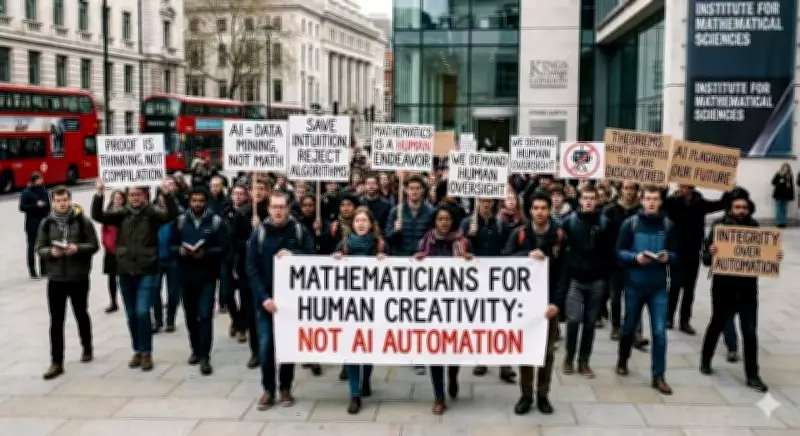
Dozens of mathematicians signed a declaration on Tuesday calling for the discipline to resist promoting artificial intelligence developers. The researchers warn that AI is threatening fundamental values of mathematics. The rise of AI forces mathematicians to rethink what makes their field reliable and valuable.
Leiden Declaration
The 'Leiden Declaration', backed by mathematicians and professors from Europe, Japan, and the US, warns governments not to "believe the hype" about AI's mathematical abilities. It urges governments to regulate the AI industry and invest in public alternatives to commercial technologies to prevent power concentration in private hands.
The intervention follows claims by AI companies of increasing capability, including performance in elite competitions and alleged solutions to open problems. The International Mathematical Union (IMU) officially supports the declaration. Ulrike Tillmann, Vice President of IMU, stated: "We take the rapid development and impact of AI on our discipline very seriously. It opens new opportunities but raises questions that cannot be left unexamined. By endorsing the declaration, the IMU affirms that the future of mathematical research must be guided by human judgment, fair practices, and shared values. Mathematics is, and should always remain, a profoundly human endeavour."

Key Parts of the Declaration
The preamble notes that technological developments have repeatedly transformed mathematics. Recent AI technologies, including symbolic and neural methods, may have initiated a significant chapter. Researchers have mixed reactions: enthusiasm, intimidation, indifference, and concern. Mathematicians have a choice about adopting AI and a responsibility to ensure the discipline's flourishing.
The declaration provides recommendations for individuals, institutions, governments, and industry. It applies to research, education, mentoring, publishing, funding, and science policy. It stands in solidarity with other research endeavors and complements other calls for action like the Uppsala Code of Ethics and UNESCO Recommendation on Open Science.
Values to Preserve
The declaration bases recommendations on characteristic values of mathematical research:
- Proof: Mathematical proofs confer certainty and understanding, supporting scientific integrity.
- Attribution: Results are attributable to authors who take credit and responsibility.
- Transparency: Arguments are transparent and subject to independent verification without proprietary knowledge.
- Evaluation: Proper evaluation relative to shared standards of depth and significance.
- Autonomy: Autonomous shaping of research directions and methods.
Potential Threats
Recent AI developments threaten these values, disproportionately affecting students and early-career mathematicians:
- Unreliable arguments: AI can produce plausible but incorrect arguments, undermining review systems.
- Attribution issues: Models trained on published works often fail to cite sources and may violate copyright.
- Incentive disruption: AI use may become incentivized for its own sake, disadvantaging researchers without access.
- Improper evaluation: Results communicated via press releases bypass peer review, overemphasizing AI's role.
- Loss of autonomy: Technology companies may prioritize problems amenable to AI over deeper significance.
These challenges arise amid wider concerns about AI in warfare, surveillance, and environmental damage. The declaration calls for urgent action and encourages professional organizations to endorse it.