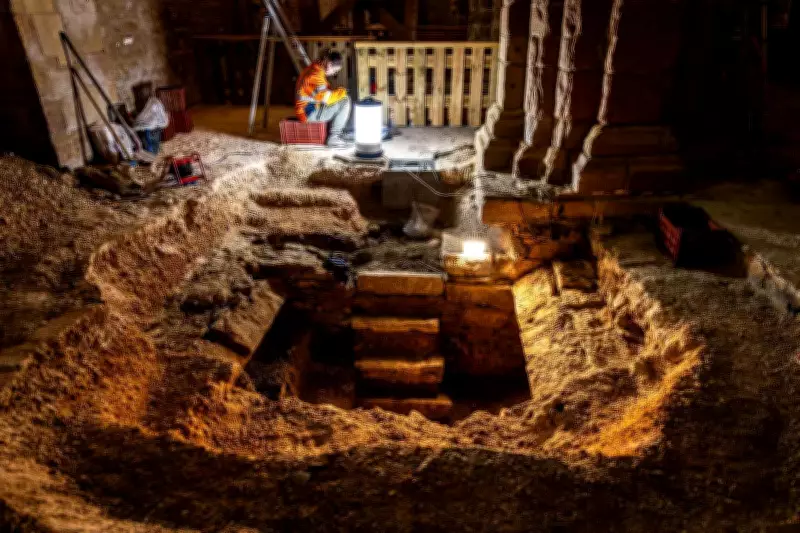
Many times, there is much more to a historic building than meets the eye, often right under everyone's feet. In the medieval stone walls of the Church of Saint Philibert in Dijon, France, what was intended as a simple maintenance project turned into a significant archaeological discovery. The floor of the church concealed a secret that had been omitted from any modern architectural plans.
This discovery occurred when workers were repairing the flooring. While removing sections of the floor and concrete layer, they found a vertical stone staircase leading straight into the ground below. The staircase opened directly into an underground burial chamber, a late-medieval/early-modern burial vault.
As the investigation continued, however, the scope of the discovery extended far beyond that single room. This staircase turned out to be an access point into a stratified landscape, consisting of remnants and historical sites that shed light on more than one thousand years of the area's development.

Exploring the Unexpected Structural Stratification Beneath the Floor
What prompted this unexpected discovery was not an attempt to explore remains but structural issues concerning moisture retention and mineral accumulation. During the 1970s, a heated concrete floor was installed inside the medieval church. However, this innovation led to a considerable amount of salt being trapped within the foundations, which had previously been used as a salt storage facility in the 18th and 19th centuries. The heating process caused these minerals to expand, creating cracks in the structure.
This field investigation was undertaken by the National Institute for Preventive Archaeological Research in France. Specialists compiled the exact technical information related to the site in a report titled "Sous les piliers de l’église Saint-Philibert de Dijon." While removing the concrete layer systematically, experts found an extensive series of graves.
Within the core area of the church structure, researchers discovered a series of wooden coffins in the conventional east-west alignment pattern. During their explorations of the main intersection, they came across a burial vault from the 15th-16th centuries, where bones had been carefully gathered and sorted to make room for future burials. Further exploration revealed a stratified landscape of historical sites, including 15th-century vaults, 11th-century graves, and six Merovingian sarcophagi. This discovery showcases over a thousand years of the area's development, with evidence of a 10th-century church beneath the current medieval structure.
Excavating the Foundations of a Medieval Society
While field technicians cleared layers of dirt and debris, they discovered that the timeline of events at the site reached much further into the past than merely the construction of the 12th-century church. Under the layers of burials from the medieval period, the team found evidence of older graves, dating back to the 11th century. Still more deeply buried, the excavation yielded six massive stone sarcophagi, constructed in the characteristic style of the Merovingian period.
The overall architectural history of the site is explained in the previously referenced report. According to these findings, the team discovered the remains of another church structure that existed at this site in the 10th century. These remains were identified by analyzing the herringbone pattern used in the construction of this building, which is typical for early medieval structures.
This finding marks another example of the tendency seen throughout European history, where new churches were built over old structures to preserve the sacredness of the place and ensure stable foundations. By uncovering these layers, the archaeological dig has allowed historians to see a vertical timeline of the area's development from late antiquity through the medieval ages to the present day.