

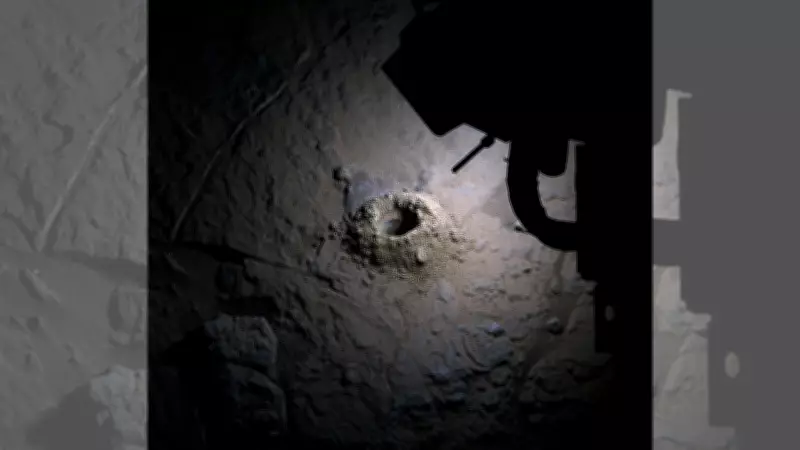
NASA's Curiosity Rover Illuminates Martian Night with LED Lights
In a remarkable feat of extraterrestrial photography, NASA's Curiosity rover has captured a rare nighttime image of the Martian surface by utilizing LED lights mounted on the end of its robotic arm. This unusual after-dark view offers scientists a unique perspective on the Red Planet's geological features that are typically hidden in shadow.
Technical Details of the Nighttime Capture
According to NASA, the image was taken on December 6, 2025, during the rover's 4,740th Martian day (sol) on Mars. The photograph was recorded by Curiosity's Mast Camera (Mastcam) while the surface below was illuminated by LED lights from the Mars Hand Lens Imager (MAHLI), a specialized camera attached to the rover's robotic arm.
These LEDs are typically employed during daylight operations to illuminate areas that remain in deep shadow, such as the interiors of drill holes or inlet tubes leading to instruments inside the rover. Earlier in the mission, scientists also used MAHLI's lights at night to study layering and other features inside drill holes that could reveal crucial details about a rock's composition.

Why Nighttime Observations Became Rare
NASA explained in a release that such nighttime observations had become increasingly uncommon after Curiosity changed its drilling technique. The newer drill holes often emerged too rough and dusty to clearly show internal features, making nighttime illumination less effective for scientific analysis.
However, a breakthrough occurred after drilling a rock target nicknamed "Nevado Sajama" on November 13, 2025 (Sol 4,718). The mission team discovered that the drill hole walls were smooth enough to attempt nighttime illumination once again. Scientists then decided to use the MAHLI LEDs to light the area and capture this exceptional image.
Geological Context of the Discovery
The drilling was conducted during Curiosity's exploration of a region marked by distinctive "boxwork" formations. These mineral-rich structures crisscross the Martian landscape for miles and resemble giant spiderwebs when viewed from orbit, providing valuable insights into the planet's geological history.
Mission Background and Contributors
Curiosity was built by NASA's Jet Propulsion Laboratory (JPL), which is managed by Caltech in Pasadena, California. JPL leads the mission for NASA's Science Mission Directorate as part of the agency's comprehensive Mars Exploration Program. Malin Space Science Systems in San Diego built and operates both the Mastcam and MAHLI instruments that made this nighttime photography possible.
This innovative use of existing technology demonstrates how NASA continues to maximize scientific returns from its Martian missions, even years after Curiosity's initial landing. The nighttime image represents not just a technical achievement but also opens new possibilities for understanding Martian geology under different lighting conditions.

