

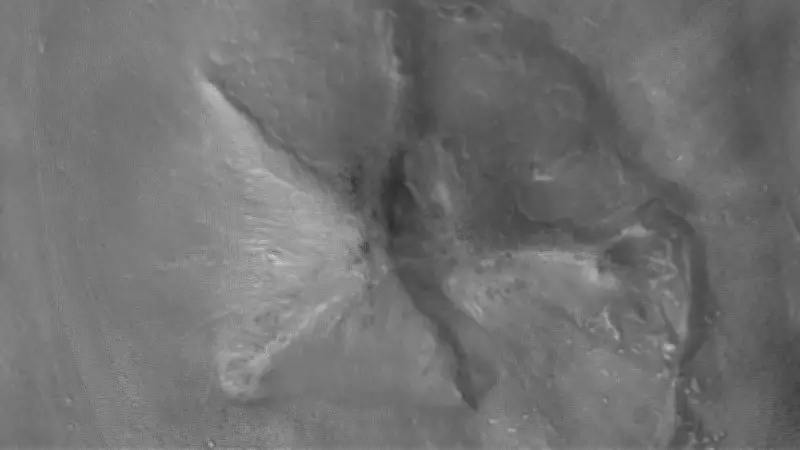
NASA Debunks Viral 'Mars Pyramid' as Natural Geological Formation
The excitement surrounding the Red Planet has surged with the viral spread of images showing a three-sided pyramid on Mars, igniting global speculation about ancient extraterrestrial civilizations. This structure, located in the western area of Candor Chasma within the vast Valles Marineris canyon system, exhibits remarkable geometric symmetry that has captivated social media and news agencies worldwide.
Discovery and Viral Sensation
Originally identified in 2001 by Keith Laney using data from NASA's Mars Global Surveyor, the feature was cataloged as an 'Interior Layered Deposit' (ILD) or geomorphic knob. However, it gained renewed attention in March 2026 when filmmaker Brian Dobbs shared processed 3-D satellite imagery highlighting its sharp edges and size, comparable to the Great Pyramid of Giza. Official measurements reveal it is nearly 3 kilometres wide, making it over ten times larger than its Egyptian counterpart.
This visual similarity has led many to argue for an artificial origin, suggesting it could be evidence of past Martian life. The structure's appearance across multiple satellite missions over two decades has fueled these claims, making it a focal point for enthusiasts of extraterrestrial theories.

Scientific Explanation: Interior Layered Deposits
According to data from NASA's official Photojournal and the High Resolution Imaging Science Experiment (HiRISE) camera, the pyramid is not a human construction but a natural geological formation. Scientists classify it as an ILD, which are large masses of isolated hills formed from sediments deposited by melting permafrost into canyon floors.
These sediments consist of hydrated sulfates like gypsum and iron oxides, creating solid, resistant layers. Erosion by the thin Martian atmosphere over billions of years has sculpted these layers into sharp, angled edges rather than rounded hills, explaining the pyramid-like appearance.
USGS Research and Natural Origins
A study led by USGS researchers, published in a scientific journal, supports this natural explanation. The pyramid is identified as one of many 'Type 3 Geomorphic Knobs' in the Valles Marineris system. The research attributes its shape to eolian sculpting, where dominant Martian winds act as natural sandblasters, eroding rock to form three-sided structures known as 'Dreikanters'.
Furthermore, the pyramid's faces align with principal Candor Chasma rift fault lines, indicating that natural weaknesses in the Martian crust have influenced its formation. This geological evidence strongly counters theories of artificial construction, emphasizing the role of wind and tectonic fracture erosion over immense timescales.
Global Impact and Ongoing Interest
Despite NASA's debunking, the viral nature of this story underscores enduring public fascination with Mars and the search for extraterrestrial life. The combination of high-resolution imagery and social media amplification has kept this topic in the spotlight, highlighting how scientific discoveries can capture global imagination.
As exploration of Mars continues with missions like those from NASA and other space agencies, such features will likely be studied further, but for now, the scientific consensus remains clear: this Martian pyramid is a testament to the planet's dynamic geological history, not evidence of ancient civilizations.






