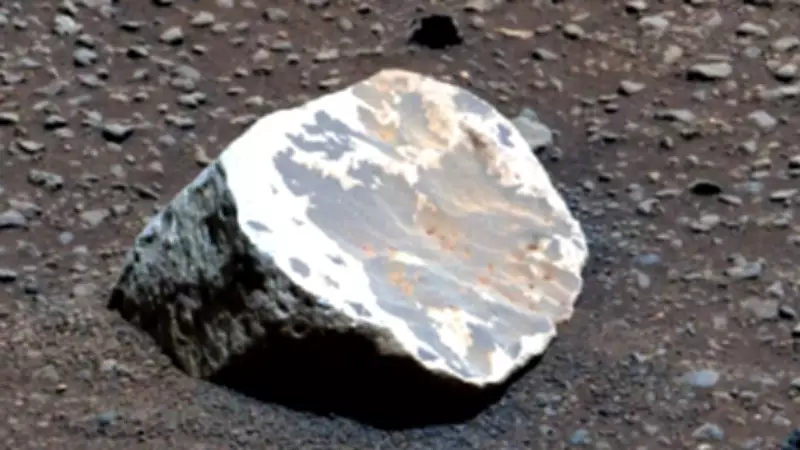
Bright white rocks scattered across the rusty red plains of Mars have captured the attention of scientists worldwide. NASA's Perseverance rover spotted these intriguing formations in Jezero crater, and researchers have been studying them intently ever since their discovery.
Not Just Ordinary Rocks
At first glance, these white formations might appear ordinary, but detailed analysis reveals a fascinating story. These aren't just typical Martian rocks—they're kaolinite clays, rich in aluminum and relatively rare in the solar system. On Earth, such clays form only after millions of years of warm, wet rainfall that gradually shapes landscapes through persistent weathering processes.
Implications for Martian Climate History
The discovery of kaolinite clays on Mars suggests the Red Planet might once have experienced long periods of rainfall, potentially lasting for millions of years. This finding challenges previous assumptions about Mars as a perpetually frozen, arid world and opens new possibilities for understanding its climatic evolution.

The rocks were identified using Perseverance's sophisticated SuperCam and Mastcam Z instruments, which performed chemical analysis comparing the Martian samples with similar Earth-based specimens from regions like California and South Africa. These terrestrial locations are known for their wet conditions and geological processes involving sustained water exposure.
Scientific Perspectives and Challenges
"It's tricky," noted Adrian Broz, a postdoctoral researcher at Purdue University, regarding the interpretation of these findings. "Kaolinite requires long, sustained water exposure. That doesn't happen easily in most environments."
Jezero crater, where the discovery was made, once contained a lake approximately twice the size of Lake Tahoe. Scientists are considering multiple theories about how these white clays formed and distributed themselves across the Martian landscape:
- Ancient rivers might have transported minerals throughout the region
- Asteroid impacts could have spread the distinctive white clays
- Sustained rainfall over geological timescales may have created the formations
The exact origin remains uncertain, requiring further investigation and analysis.
Evidence of Persistent Wet Conditions
Professor Briony Horgan, a planetary scientist at Purdue University, emphasizes that similar rocks are exceptionally rare on Earth because they form slowly under constant water exposure. Their presence on Mars strongly hints at persistent wet conditions that might have created oases lasting for millions of years.
The clay fragments discovered range from small pebbles to substantial boulders, with even the tiniest pieces carrying chemical signatures indicating sustained rainfall. This evidence directly contradicts older scientific models that portrayed Mars as a predominantly dry, frozen world throughout its history.
Advanced Instrumentation and Analysis
Perseverance's cutting-edge instruments have enabled unprecedented comparison between Martian rocks and their Earth analogues. The SuperCam system measures composition and mineralogy while providing high-resolution images that reveal minute details about the geological formations.
While rainfall currently appears as the simplest explanation for these kaolinite formations, scientists caution that it remains a hypothesis requiring further verification through additional data collection and analysis. The ongoing mission continues to gather evidence that will help clarify Mars' ancient climate patterns and potential habitability.
This discovery represents another significant step in understanding the geological and climatic history of our planetary neighbor, potentially reshaping our comprehension of how water has shaped worlds throughout our solar system.