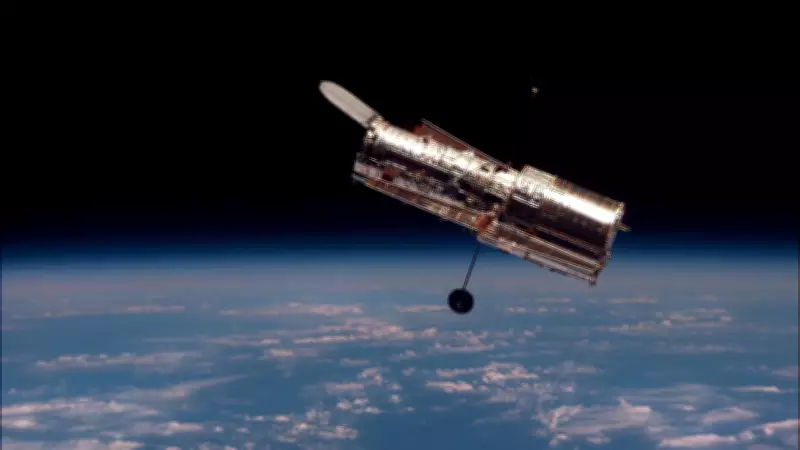
Through NASA's Hubble Telescope, humanity has embarked on an extraordinary journey across the universe. Since its launch in 1990, the Hubble Space Telescope has orbited nearly 300 miles above Earth, transforming our understanding of the cosmos. Traveling at an incredible speed, it circles the Earth every 95 minutes, capturing breathtaking images across ultraviolet, visible, and near-infrared light.
The Butterfly Nebula
The spectacular planetary nebula NGC 6302, known as the Butterfly Nebula, resembles the delicate wings of a cosmic butterfly. Located nearly 4,000 light-years away in the constellation Scorpius, Hubble captured remarkable details revealing the final stages of a star's life. Spanning over 3 light-years across, this glowing cloud of gas shines intensely in ultraviolet light, illuminating the surrounding nebula with vivid colors and intricate structures.
Pillars of Creation
The Pillars of Creation are iconic towering structures captured by Hubble within the Eagle Nebula, nearly 7,000 light-years from Earth. These stunning columns of gas and cosmic dust serve as a stellar nursery where new stars are born. The towers glow intensely under ultraviolet radiation, displaying vivid colors: blue for oxygen, red for sulfur, and green for hydrogen and nitrogen.

The Celestial Fossil
NGC 1841 is a globular cluster located within the Large Magellanic Cloud, a satellite galaxy of our Milky Way, about 162,000 light-years away. Globular clusters are like celestial fossils, providing insights into very early star formation in galaxies.
The Dumbbell Nebula
Captured in celebration of Hubble's 34th year in orbit, the Little Dumbbell Nebula (M76) showcases the dramatic final stages of a dying star's life. This planetary nebula formed when a red giant star expelled its outer layers into space before collapsing into a dense white dwarf. It features a unique hourglass-like structure with a glowing central ring and expanding lobes of gas.
The Saturnian Summer
In July 2020, Hubble captured an ethereal image of Saturn during summer in the planet's northern hemisphere, revealing subtle seasonal changes in its atmosphere. A reddish haze caused by increased sunlight and shifting atmospheric activity contrasts with cooler blue tones in the southern hemisphere, shaped by winter conditions. This image helps scientists understand the evolving weather, storms, and atmospheric dynamics of outer planets in our solar system.