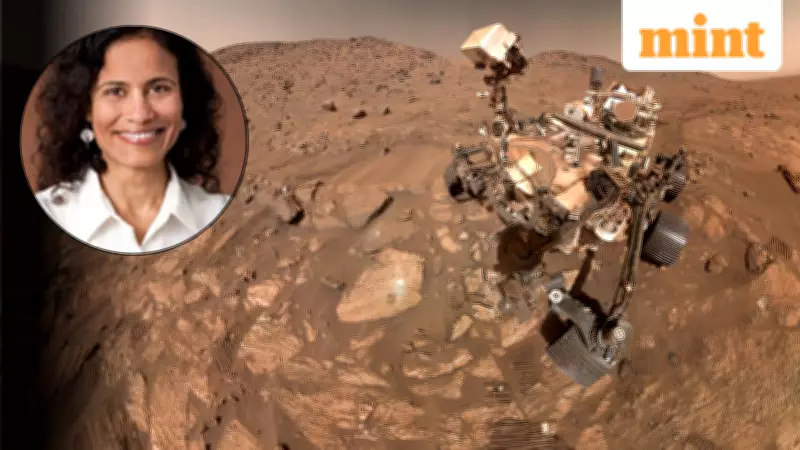
A few days ago, NASA revealed a monumental achievement in space exploration: the first-ever artificial intelligence-driven exploration of another planet, conducted by the Perseverance rover on Mars. This pioneering initiative was spearheaded by Indian-origin scientist Vandi Verma, marking a significant milestone in autonomous space missions.
Historic AI-Driven Drives on Martian Terrain
On December 8 and 10, 2025, NASA's Perseverance rover successfully completed drives on Mars using routes planned entirely by artificial intelligence, without any human intervention. This demonstration took place along the rim of the Jezero Crater on Mars, leveraging a generative AI vision-language model to analyze the Martian terrain and plot safe routes through designated waypoints.
NASA Leadership Hails Technological Advancement
NASA Administrator Jared Isaacman announced the success, stating, "This demonstration shows how far our capabilities have advanced and broadens how we will explore other worlds." He emphasized that autonomous technologies like this can enhance mission efficiency, navigate challenging terrain, and increase scientific returns as distance from Earth grows. Isaacman added, "It's a strong example of teams applying new technology carefully and responsibly in real operations."

The Indian Connection: Vandi Verma's Role
This landmark moment was orchestrated by the Rover Operations Center (ROC) under NASA's Jet Propulsion Laboratory (JPL), where India-born Vandi Verma is a key member. Verma's expertise in robotics and autonomous systems has been instrumental in advancing NASA's exploration capabilities.
Who is Vandi Verma?
Born and partly raised in Halwara, Punjab, Vandana 'Vandi' Verma is the daughter of an Indian Air Force pilot. She is one of the few individuals on Earth qualified to operate a vehicle on Mars. Verma's academic journey includes:
- A bachelor's degree in electrical engineering from Punjab Engineering College in Chandigarh
- A master's degree in robotics from Carnegie Mellon University in Pittsburgh, Pennsylvania
- A PhD in robotics from Carnegie Mellon University in 2005, with a thesis titled "Tractable Particle Filters for Robot Fault Diagnosis"
During her time at Carnegie Mellon, Verma developed a keen interest in robotics for unknown environments and completed internships at NASA's Ames Research Center. She also field-tested a rover in South America's Atacama Desert to search for signs of life, foreshadowing her current work at NASA.
Verma's Career at NASA and Contributions
Beyond her cutting-edge research, Verma is a certified pilot. She joined NASA's JPL in 2007 and by 2019 was leading the Autonomous Systems, Mobility, and Robotic Systems group. Her previous work includes contributions to NASA's Curiosity rover, and she currently oversees AI-driven exploration with the Perseverance rover.
Future Implications of AI in Space Exploration
Commenting on the recent achievement, Verma explained, "The fundamental elements of generative AI are showing a lot of promise in streamlining the pillars of autonomous navigation for off-planet driving: perception [seeing the rocks and ripples], localization [knowing where we are], and planning and control [deciding and executing the safest path]."
She added, "We are moving towards a day where generative AI and other smart tools will help our surface rovers handle kilometer-scale drives while minimizing operator workload, and flag interesting surface features for our science team by scouring huge volumes of rover images." This advancement signals a transformative shift in how robotic missions will operate on distant planets, enhancing both efficiency and scientific discovery.