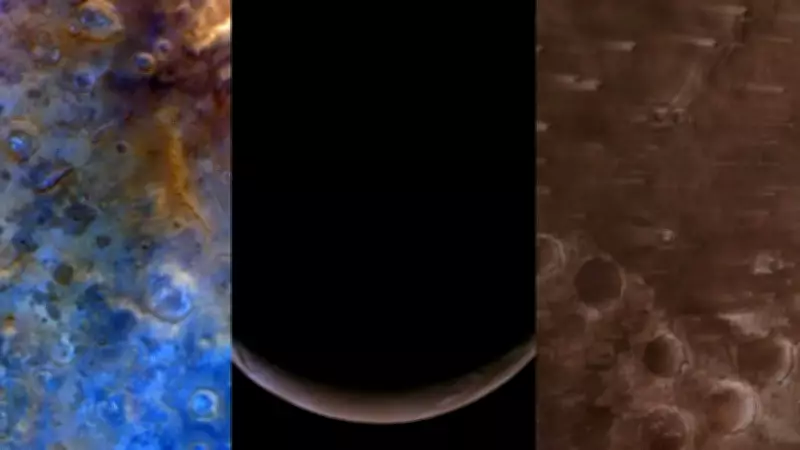
NASA's Psyche spacecraft has successfully executed a dramatic flyby of Mars, capturing striking close-up views of the Red Planet, including the massive Huygens Crater. The maneuver serves as a slingshot, propelling the spacecraft deeper into the solar system on its billion-mile journey to a mysterious metal-rich asteroid.
Mars Flyby Details
The spacecraft swept just 4,609 kilometers above Mars on May 15, using the planet's gravity like a cosmic catapult to gain speed without burning additional fuel. NASA confirmed that the maneuver boosted Psyche's velocity by nearly 1,000 miles per hour and adjusted its orbital path toward the asteroid belt located between Mars and Jupiter.
While the flyby was primarily a technical pit stop, it also provided a unique scientific opportunity. As Psyche approached Mars from an unusual angle, the planet appeared as a glowing crescent wrapped in dusty sunlight. Its onboard cameras snapped thousands of images of the Martian surface and atmosphere, offering a rare perspective that even seasoned space scientists found remarkable.

Huygens Crater and Scientific Observations
Among the standout visuals captured during the flyby was Huygens Crater, a giant scar on Mars named after Dutch astronomer Christiaan Huygens. These images were taken as the spacecraft transitioned from the planet's night side into daylight during its closest approach.
NASA scientists emphasized that the encounter also served as a full dress rehearsal for Psyche's main mission. Every major instrument aboard the spacecraft, including imagers, magnetometers, and radiation detectors, was activated and tested during the Mars pass. This successful test ensures the spacecraft is ready for its primary objective.
Mission to Asteroid Psyche
The spacecraft is ultimately headed toward asteroid Psyche, a bizarre object believed to be the exposed metallic core of an ancient failed planet. Scientists hope that studying this asteroid could provide an unprecedented glimpse into what lies deep beneath rocky worlds like Earth. The asteroid's composition may reveal secrets about the formation of planets and the early solar system.
Now, with Mars fading in the rear-view mirror, Psyche is back on course for its historic rendezvous with the asteroid in 2029. The spacecraft will continue its journey, relying on its ion propulsion system to reach the asteroid belt.
About the Author
The TOI Science Desk stands as an inquisitive team of journalists, ceaselessly delving into the realms of discovery to curate a captivating collection of news, features, and articles from the vast and ever-evolving world of science for the readers of The Times of India. Consider us your scientific companion, delivering a daily dose of wonder and enlightenment. Whether it's the intricacies of genetic engineering, the marvels of space exploration, or the latest in artificial intelligence, the TOI Science Desk ensures you stay connected to the pulse of the scientific world. At the TOI Science Desk, we are not just reporters; we are storytellers of scientific narratives. We are committed to demystifying the intricacies of science, making it accessible and engaging for readers of all backgrounds. Join us as we craft knowledge with precision and passion, bringing you on a journey where the mysteries of the universe unfold with every word.