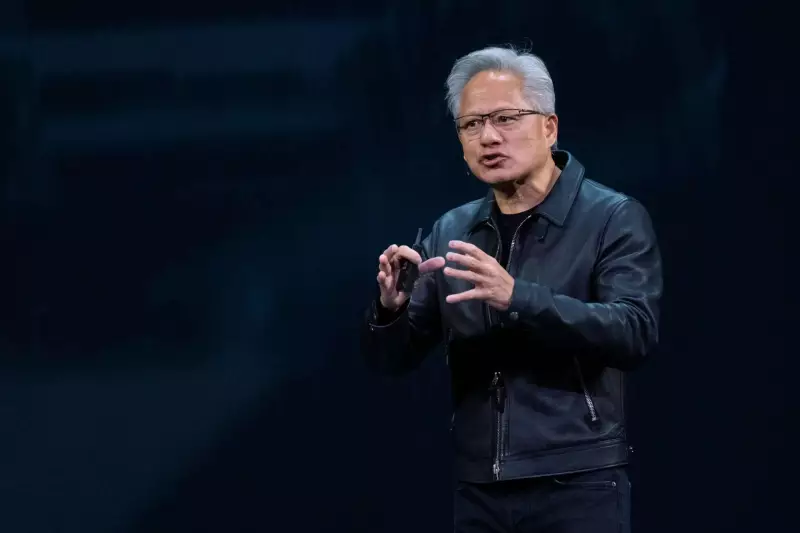
Nvidia's Chief Executive Officer Jensen Huang found himself at the centre of a media storm after his recent comments on the artificial intelligence race between China and the United States were widely interpreted as declaring China the winner. The remark gained so much traction that the tech billionaire had to issue a detailed clarification during a recent public appearance.
The Provocative Statement and Its Aftermath
During a fireside chat at the prestigious Center for Strategic and International Studies (CSIS), Huang was directly questioned about his earlier statement by CSIS President John Hamre. Hamre labelled the comment "very provocative," referencing Huang's apparent assertion that China was winning the AI competition and highlighting the formidable challenge posed by Chinese tech giant Huawei.
In his response, Huang acknowledged that his earlier words had "caught a lot of attention" and that crucial context was lost in sensational headlines. To properly frame the discussion, he proposed analysing the AI ecosystem as a five-layer structure: Energy, Chips, Infrastructure, Models, and Applications.

Breaking Down the Five-Layer AI Cake: Where America Lags
Huang proceeded to handicap the competition from the bottom layer upwards. He identified the foundational layer, energy, as a critical weak spot for the United States. "At the lowest level, China has twice the amount of energy we have as a nation," Huang stated, expressing bewilderment given the larger size of the US economy. He emphasised that this energy deficit is a potential 'deal breaker' for America's reindustrialisation ambitions.
He connected this to a conversation with former President Donald Trump, who stressed the need to "reindustrialize America" and bring manufacturing back onshore. Huang pointed out the paradox: "We want to reindustrialize the United States. How do you do that without energy?" He commended Trump for championing the necessity of energy for national growth, calling it "one of the greatest things he's done right off the bat."
US Strengths and the Complacency Warning
Moving to the second layer, semiconductor chips, Huang offered a more reassuring assessment for America. "We're generations ahead on chips, and I think everybody recognizes that," he asserted. However, he immediately followed this with a stark warning against complacency. He reminded the audience that chipmaking is fundamentally a manufacturing process, and dismissing China's manufacturing prowess would be a grave mistake. "Anybody who thinks China can't manufacture is missing a big idea," he cautioned.
The third layer, infrastructure, revealed another area where China holds a significant advantage, according to Huang. He contrasted the lengthy timelines in the US, where building an AI data center from scratch can take about three years, with China's remarkable speed. "They can build a hospital on a weekend. That's a real challenge," he said, attributing this to China's identity as a nation of builders with "extraordinarily high" velocity.
While Huang did not delve deeply into the top layers—AI models and applications—during this clarification, his analysis painted a nuanced picture. It is not a simple matter of one country leading in all aspects. The United States maintains a generational lead in core semiconductor technology, but faces substantial challenges in energy capacity and infrastructure development speed, areas where China is currently stronger and building rapidly.