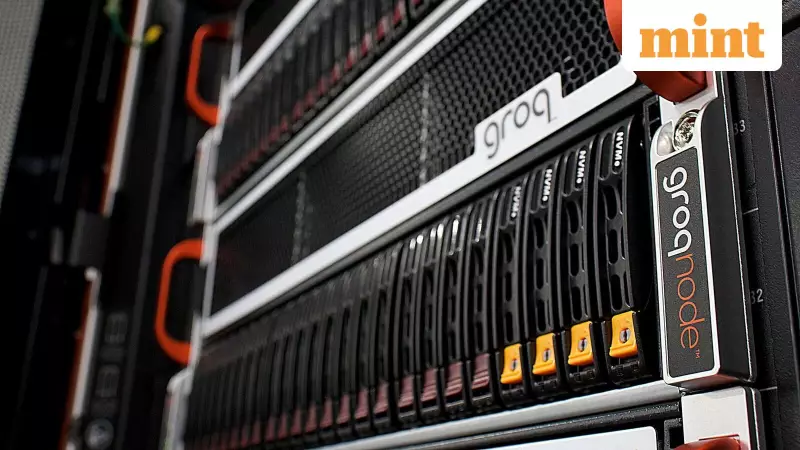
The artificial intelligence sector is facing renewed scrutiny over its soaring valuations and funding practices following a landmark deal announced on Christmas Eve. Chipmaking giant Nvidia revealed an agreement to license technology, acquire assets, and hire key personnel from the AI chip startup Groq. Valued at a staggering $20 billion, this transaction ranks among the largest in the AI industry and has intensified debates about a potential investment bubble and controversial 'circular financing' arrangements.
The Rise of Circular Financing and Valuation Concerns
This deal has brought the spotlight back on complex financial agreements where the line between investment and vendor financing is increasingly blurred. A prominent example occurred in September 2025, when Nvidia outlined plans to deploy up to $100 billion in AI data centre capacity for OpenAI. This commitment was contingent on OpenAI purchasing millions of Nvidia's chips as the systems were constructed.
In a similar vein, OpenAI entered a deal with AMD in October 2025, receiving warrants for up to a 10% stake in the chip company. These warrants vest as OpenAI deploys AMD's processors. Analysts warn that such arrangements create a cycle of 'circular financing,' where invested capital flows back to the investor through obligated purchases. This pattern draws parallels to vendor financing schemes that artificially inflated demand during the telecom and internet booms, raising serious questions about the sustainability of current AI infrastructure investments.

The financials of leading players underscore these tensions. OpenAI, valued at approximately $500 billion, reported revenue of $4.3 billion for the first half of the year. However, it also burned through $2.5 billion in cash and recorded operating losses exceeding $7 billion. According to estimates from Goldman Sachs, AI-related company valuations have surged by more than $19 trillion since late 2022, potentially running ahead of plausible long-term economic returns.
AI Infrastructure Boom and Overbuild Warnings
Driving this dealmaking frenzy is a massive build-out of AI infrastructure by tech majors anticipating explosive growth in computing demand. In 2025, Microsoft, Amazon, Meta, Alphabet, and Oracle collectively spent a colossal $399 billion on this infrastructure. Bank of America projects this figure could reach $620 billion by 2028.
This spending has fueled record dealmaking. Data-centre transactions totalled nearly $61 billion through November 2025, as per S&P Global Market Intelligence. Goldman Sachs further estimates that global AI infrastructure investment could balloon to $3-4 trillion by 2030. Such a rapid pace has sparked sustainability concerns. CreditSights estimates that capital expenditure now accounts for half or more of the operating cash flow for several major 'hyperscaler' companies. Echoing these concerns, Microsoft CEO Satya Nadella warned in February 2025 that "there will be an overbuild" of AI capacity.
Corporate Adoption and Regulatory Scrutiny Intensify
Despite the risks, there is strong optimism rooted in accelerating business adoption. McKinsey's 2025 Global Survey found that 88% of organisations now use AI in at least one business function, a significant jump from 78% in 2024 and roughly 50% before the rise of generative AI. Another consultancy, Deloitte, reported that 79% of CEOs were implementing generative AI for innovation purposes.
Larger companies are leading the charge. McKinsey's November report noted that nearly half of respondents from firms with over $5 billion in revenue have reached the scaling phase, compared to just 29% of those with under $100 million in revenues. Early benefits are emerging in software engineering, manufacturing, and IT. However, only 6% of organisations currently generate substantial earnings (EBIT) from AI, indicating that widespread value capture requires systematic workflow redesign, not just isolated pilot projects.

Parallel to this growth, regulatory activity has surged globally, signalling the sector's maturation. The Stanford AI Index Report noted that US federal agencies introduced 59 AI-related regulations in 2024, more than double the previous year's total. Legislative mentions of AI across 75 countries increased by 21.3% to 1,889. The landmark EU AI Act came into force in August 2024, with phased obligations starting in 2025. Governments from Saudi Arabia and France to China are committing billions to achieve AI 'sovereignty,' further heating up global competition.
The Nvidia-Groq deal, therefore, sits at the crossroads of unprecedented technological promise and profound financial and regulatory uncertainty. How the industry navigates the twin challenges of unsustainable financing and tightening rules will define its trajectory in the coming years.