

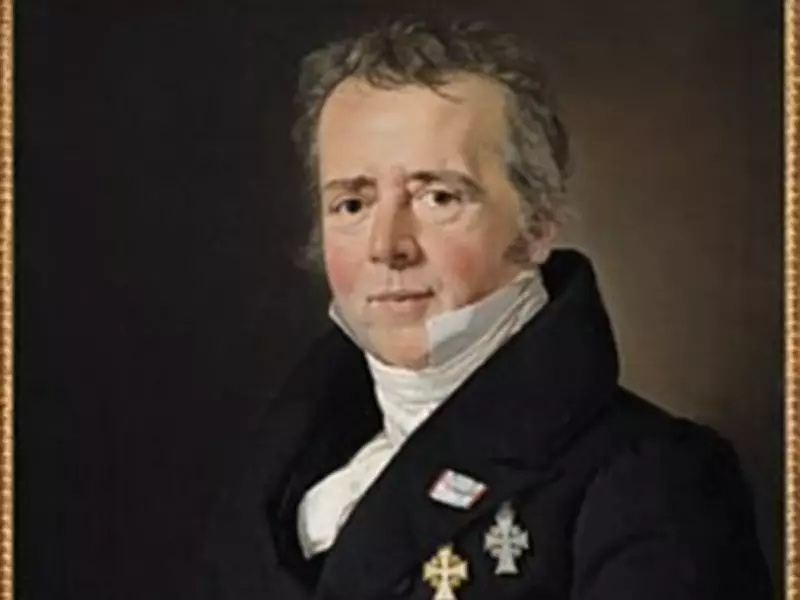
In 1820, Danish physicist Hans Christian Oersted made a discovery that would profoundly shape the course of human history. While preparing for a lecture demonstration, he observed that a compass needle deflected when an electric current flowed through a nearby wire. Though the effect was transient, it revealed a fundamental link between electricity and magnetism, now a cornerstone of modern physics.
The Accidental Breakthrough in a Classroom
The discovery occurred under remarkably ordinary conditions. Oersted was setting up his lecture equipment—a simple battery connected to a wire—when he noticed the compass needle move. Unlike other scientific breakthroughs that relied on complex machinery, this one emerged from a routine classroom setup, without any intent to uncover a new law of nature.
Historical accounts describe Oersted's finding as a serendipitous event during a lesson. This human element is crucial: the discovery was made in the presence of students, in a learning environment, underscoring the value of education and observation in scientific progress.

Understanding the Compass Needle's Movement
To grasp the discovery's significance, a review by the National Institute of Standards and Technology explains that an electric current generates a magnetic field around the wire, affecting nearby compass needles. Before Oersted, electricity and magnetism were studied separately. His work prompted scientists to explore them together, opening new avenues for research.
Historical documents from the National High Magnetic Field Laboratory highlight that the needle deflected only when the circuit was switched on or off, proving the effect was due to electrical current, not external factors. This simple observation revolutionized science.
From a Single Observation to a New Field of Study
Oersted's discovery was not an isolated event; it sparked rapid progress by other scientists like Arago, Ampère, and Faraday. Within years, the phenomenon led to the formulation of laws and the development of electromagnetism. The temporary magnetic effect observed when the battery was connected and disconnected laid the groundwork for electrical machines, as noted in a PubMed publication on the history of electrical machines.
The scientific legacy is also evident in units of measurement: the unit "oersted" was named in his honor, cementing his place in physics history. Such recognition underscores the fundamental nature of his work.
Relevance of the Story Today
Oersted's compass experiment remains significant because it demonstrates how major discoveries can arise from humble beginnings. Using simple apparatus in an unremarkable setting, he opened a new line of inquiry in electromagnetism. The fleeting observation prompted deeper questions: why does current affect a magnetic needle? This led to further investigations and ultimately to the theory of electromagnetism.
The 1820 experiment serves as a reminder that scientific breakthroughs need not be grand. They can start from a lab class, a battery, a wire, and a compass needle moving at just the right moment. Oersted's genius lay not just in observing but in recognizing the significance of his observation.
About the Author
This article is brought to you by the TOI Science Desk, a team of inquisitive journalists dedicated to curating captivating science news and features. We strive to demystify complex topics, making science accessible to all. Join us as we explore the wonders of the universe, one story at a time.






