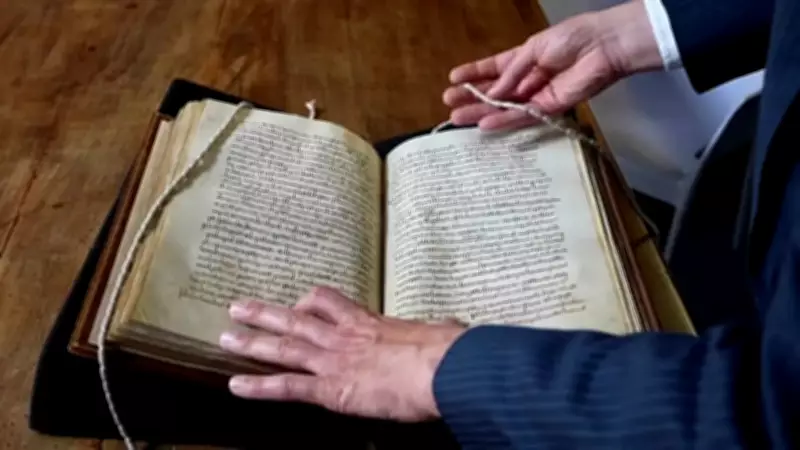
Historians have uncovered a medieval manuscript containing one of the oldest surviving copies of the earliest known poem in English, Caedmon's Hymn, in a Roman library. The discovery, made by researchers from Trinity College Dublin, could reshape understanding of the English language and its literary spread across medieval Europe.
What Was Found?
The manuscript holds a rare version of Caedmon's Hymn, a nine-line Old English poem composed over 1,300 years ago. It is tucked inside a Latin manuscript from the early ninth century, with the Old English verses integrated into the main text rather than in the margins. This detail is significant because it suggests English was taken seriously as a literary language alongside Latin earlier than previously thought.
The Poem's Origin
According to legend, Caedmon was a seventh-century Northumbrian cowherd who could not write but gained poetic inspiration after a dream. His hymn is considered the birthplace of English literature. The newly found manuscript dates to around 800–830 CE, making it the third-oldest surviving copy.

How Was It Discovered?
Dr. Elisabetta Magnanti and Dr. Mark Faulkner from Trinity College Dublin were searching for manuscripts of Bede's Ecclesiastical History. Conflicting references led them to the National Central Library of Rome, where they requested digital scans. Upon finding the Old English lines woven into the Latin text, they were astonished.
"We were speechless," Magnanti told the Associated Press.
Why Is This Important?
Caedmon's Hymn is the earliest known English poem. In most older manuscripts, it appears in margins or appended to Latin texts. However, in the Rome manuscript, it is part of the main narrative, indicating that English was being formally preserved as early as the ninth century. This challenges assumptions about the dominance of Latin in medieval scholarship.
The Manuscript's Journey
The book was copied by monks at the Benedictine Abbey of Nonantola in northern Italy, a major manuscript hub. It traveled through abbeys, churches, and private collections, crossing oceans before returning to Italy. Scholars lost track of it for decades until it was rediscovered in the Roman library system, largely unnoticed.
Public Reaction
The discovery sparked excitement on social media and among medieval literature enthusiasts. Some joked it was "the original English DLC," while others marveled that major discoveries are still being made. The mention of "middangeard" (middle earth) in the poem drew comparisons to Tolkien's works.
One Reddit user commented, "All I know is somebody shelved it."
Broader Implications
The finding highlights that historical treasures may still be hidden in archives worldwide. The poem survived invasions, wars, and neglect, only to reappear in the digital age. As the TOI Lifestyle Desk notes, history is not lost—it is simply misfiled, waiting for curious eyes.