

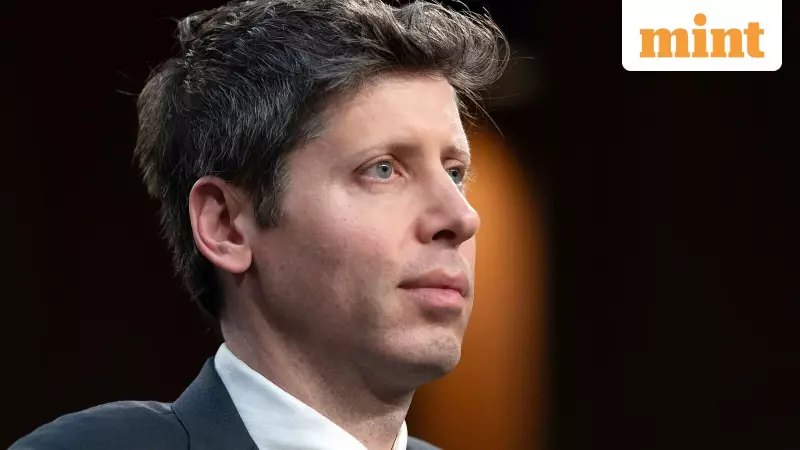
OpenAI Chief Executive Sam Altman has sounded a high-alert 'Code Red' within the company, signalling a strategic shift to counter the rising threat from Google's advanced AI model, Gemini. This move mirrors the challenge Google CEO Sundar Pichai faced when ChatGPT first disrupted the tech landscape three years ago.
OpenAI's 'Code Red' Response to Gemini's Rise
According to a report by The Information, Sam Altman communicated to employees via an internal memo that OpenAI is now in a 'Code Red' situation. This declaration has led to the postponement of several other initiatives, including work on advertising and autonomous systems. The primary goal is to channel all available resources into enhancing the capabilities of its flagship product, ChatGPT.
Altman emphasised the critical nature of the moment, stating, "We are at a critical time for ChatGPT." He called for a concerted 'surge' effort from the team. The Wall Street Journal added that to prioritise these improvements, Altman has encouraged temporary team transfers and plans for daily check-in calls with the responsible personnel.

Why Google Gemini 3 Has OpenAI Rattled
The trigger for this urgent response was the sweeping, one-day rollout of Google's Gemini 3 model two weeks ago. Released to billions of users across Google's platforms, the AI quickly gained traction. More importantly, industry benchmark tests indicated that Gemini 3 surpassed ChatGPT's performance, a development that sent Google's stock soaring.
This event marked the most decisive sign that competitors, particularly Google, have significantly narrowed OpenAI's early lead in the AI race. The competitive pressure has been building since August when Google's AI image generator, Nano Banana, was released. Google reported its monthly active users grew from 450 million in July to 650 million in October. In contrast, OpenAI recently stated that ChatGPT has reached 800 million weekly users.
OpenAI also faces a financial disadvantage, as it is not yet profitable compared to deep-pocketed rivals like Google. The company is under increased scrutiny over ChatGPT's safety while simultaneously trying to make the chatbot more engaging for users.
How OpenAI Plans to Improve ChatGPT
The internal directive, as detailed in the memo, outlines a clear focus on enhancing user experience. OpenAI now wants its employees to work on making ChatGPT more customised for individual users. Improving the model's behaviour and boosting its image generation capabilities are also top priorities.
Nick Turley, OpenAI’s head of ChatGPT, reinforced this renewed focus in a post on social media platform X late Monday. He stated the company's aim is "to keep making ChatGPT more capable, continue growing, and expand access around the world — while making it feel even more intuitive and personal."
The memo also revealed that prior to this 'Code Red', OpenAI had activated a slightly lower-risk 'Code Orange' alarm to spur improvements in ChatGPT, indicating a gradual escalation in the company's response to competitive pressures.






