

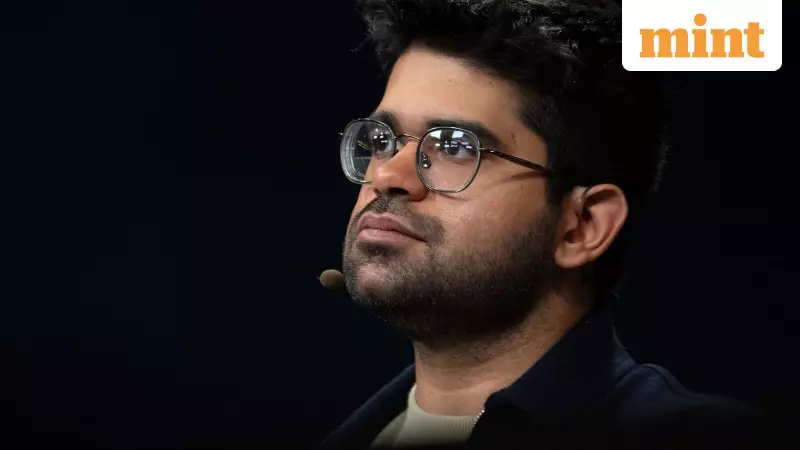
In a recent podcast conversation, Aravind Srinivas, the CEO of the AI search startup Perplexity, offered a nuanced perspective on the capabilities and limitations of artificial intelligence. While acknowledging AI's prowess in specific tasks, he firmly placed the "spark" of curiosity and problem identification as a uniquely human domain that machines have yet to breach.
The Human Edge: Curiosity and Defining Problems
Srinivas, speaking with writer and entrepreneur Prakhar Gupta on a podcast released earlier this week, challenged the notion of AI possessing genuine curiosity. He described this trait as fundamentally human, acting as the driving force behind scientific discovery and intellectual advancement.
"Did AI pose a question and try to go to solve it? No," Srinivas stated. He emphasized that the initial act of recognizing a meaningful problem and framing the right questions remains beyond the reach of current systems. AI excels at solving, optimizing, and verifying solutions for predefined problems, but it does not independently seek out what is worth solving.

"AI could help humans solve an existing problem but it is very different from AI solving it autonomously," he explained. "I think the edge would lie with the humans because it was a human who identified the problem in the first place." This, according to Srinivas, is the current boundary separating artificial and biological intelligence.
On-Device AI: A Potential Disruptor for Data Centers
One of the more striking predictions from the discussion centered on the future of AI infrastructure. Srinivas suggested that significant advances in locally run, on-device AI systems could challenge the economic model of massive, centralized data centers.
"The biggest threat to a data centre is if the intelligence can be packed locally on a chip that's running on the device, and then there's no need to run inference on all of it on one centralised data centre," he said. He outlined a scenario where powerful, compact AI models capable of high-quality inference directly on smartphones or other devices could reduce global reliance on cloud-based platforms.
Such a shift, Srinivas argued, could disrupt the billions of dollars currently being invested in data-center construction worldwide. It would also democratize access to advanced AI, enabling individuals and smaller organizations to deploy powerful systems without depending on expensive, centralized cloud infrastructure.
Efficiency and the Future of Work
Srinivas also drew a stark comparison between the energy efficiency of the human brain and modern AI data centers. He noted that the brain operates on a fraction of the power required by silicon-based systems to perform comparable cognitive tasks. This efficiency stems not just from biology but from the human mind's innate curiosity, intuition, and ability to challenge assumptions—qualities absent in today's AI by design.
Looking forward, the Perplexity CEO envisions AI reshaping work and education. He suggested that personalized, widely accessible AI tools could level the playing field between individuals and large institutions, much like smartphones did in the previous decade. By providing powerful tools regardless of a user's age or background, AI could empower a broader section of society to learn, create, and solve problems more effectively.
Ultimately, while painting a picture of a transformative AI-powered future, Srinivas's core argument reaffirms the irreplaceable value of human intuition. For now, the journey of discovery—the act of asking "why"—begins and ends with us.






