Small mammals are currently showing scientists exactly where to find huge snakes. Wildlife experts have developed a new method to combat Florida's biggest threat to wildlife. While most people think of snakes when studying this issue, researchers are using other animals to track the invasive species.
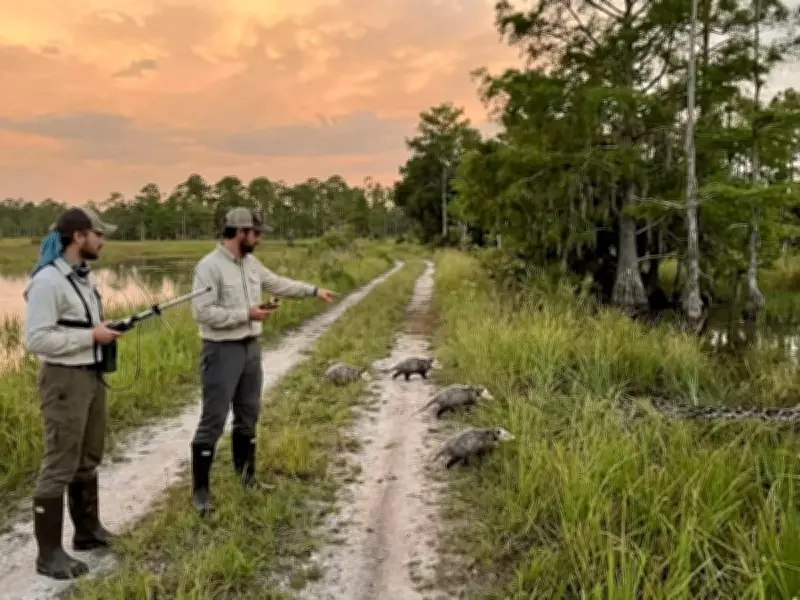
This is not how you are imagining it. While this may sound strange, the scientists are placing tracking devices on possums, and the process is working. They are able to locate giant Burmese pythons and remove them from delicate environments.
Burmese Pythons: An Invasive Species Problem
These species do not belong in Florida. Instead, the snakes arrived in the area through the exotic pet trade in the latter half of the 20th century. Eventually, the reptiles were either intentionally released or escaped into the environment, forming breeding colonies. Most breeding occurred in the Everglades National Park, then farther north, expanding their range 150 miles up the peninsula over the past 40 years to Lake Okeechobee and Fort Myers.

Now, scientists consider snakes among the worst invasive species affecting Florida's wildlife. Not only are they consuming the native wildlife, but they are also damaging the ecosystem. Scientists have learned about the magnitude of the problem. According to a study published in the USGS journal, mammals such as raccoons, rabbits, and possums saw their populations decline by 87% to 99% where snakes had formed breeding colonies in the Everglades. The snakes may grow up to 19 feet long and are hard to spot in dense forest undergrowth. As a result, locating them with standard methods is challenging even for wildlife experts.
Unexpected Turn in Finding Burmese Pythons
It was during the study of small mammals by the North Carolina Museum of Natural Sciences that a surprising observation was made by the scientists. Some of the mammals equipped with tracking devices can be used as prey for the pythons. After attaching tracking devices to the stomachs of dead snakes, researchers were able to locate and catch large pythons alive. Michael Cove, one of the biologists working on the project, commented that this turned out to be a silver lining. Following this discovery, scientists developed a way to use the method purposefully. Instead of waiting for the unexpected, they decided to track the movements of the possums to locate pythons.
How Does the Tracking System Work?
Scientists now equip possums weighing no less than three pounds with lightweight radio collars. However, these collars cannot locate an animal's position in real-time. They emit a signal only after the possum ceases its activity for a certain number of hours. In the majority of cases, such signals indicate that the possum has died. Sometimes, they mean that the animal has become a meal for a python. In that case, the collar will continue transmitting from inside the python, and researchers can track its signal to catch the snake. According to field researchers, this technique has become more viable in recent years due to reduced collar costs. Previously, the price was roughly $1,500, but now it is only $190.
Why Are Possums Great Candidates for the Task?
There are multiple reasons why possums, or opossums, are ideal candidates for this task. For one thing, they are widespread in Florida and easy to capture and handle. Also, they have smaller home ranges than other animals, such as raccoons. This means that researchers will not have to cover large distances to find signals. Moreover, researchers prefer possums because they do not venture into mangrove forests. This way, researchers can easily locate snakes in such habitats. Graduate researcher A.J. Sanjar revealed that possums are easier to work with and easier to find.

Preservation of Native Wildlife
It should be noted that the main aim of the study is not only the removal of the snakes. Instead, the protection of the native wildlife is threatened by their presence. For instance, in Key Largo, pythons hunt for endangered species such as the Key Largo woodrat and cotton mouse, which are characterised by extremely low reproduction rates. Moreover, they have natural vulnerabilities as predators. Hunting for breeding females can significantly decrease the number of eggs. It should be noted that a breeding python lays 30-60 eggs per year. Therefore, the removal of a few breeding pythons can positively influence the ecosystem.
Results of Using Possums to Track Giant Pythons
So far, the possum method has been established successfully. In just a couple of years, researchers have hunted for at least 18 snakes by this method. Most of them are over 8 feet, while some are about 13 feet long. This technique, however, also faced ethical issues and public backlash for several reasons. Some people argue that there might be a risk for these animals to become endangered. According to the scientists, they are not using the possums as bait. They are just left on their own in a place where pythons live naturally. The specialists believe this approach can be used elsewhere in Florida where pythons have spread. It can also complement the techniques which are currently being used, such as tracking dogs and monitoring.