Inside the narrow passages of Bàsura Cave in northwestern Italy, darkness is not just the absence of light. It is a physical constraint that shapes how bodies move, pause, and orient themselves. Around 14,400 years ago, a small group of Epigravettian hunter-gatherers entered this environment with a canid moving alongside them, leaving behind footprints that still trace their route through the stone corridors. A new reconstruction of prehistoric cave lighting methods in Bàsura Cave shifts attention away from the footprints themselves and into something more fragile: the short-lived flames that made those steps possible.
How Bàsura Cave Captures Life Inside Prehistoric Darkness
Bàsura Cave has been studied since the 1950s, initially with the assumption that Neanderthals might have left footprint trails. Later radiocarbon dating shifted the timeline to the late Upper Palaeolithic Epigravettian period, placing the visit near the end of the last Ice Age. The site preserves a rare behavioral snapshot: fossilized footprints from five humans, traces from a canid, charcoal smears on walls and ceilings, and large deposits of cave bear remains. Together, these elements form a kind of environmental recording of movement through roughly 800 meters of underground passages, according to research published in ScienceDirect, titled 'Archaeobotanical investigations and experimental activity performed at Bàsura Cave (Toirano, NW Italy) reveal clues on Epigravettian cave lighting systems'.
Footprints show who was there and how many. Charcoal tells us what burned. Sediments and pollen describe the external landscape they came from. When combined, they begin to describe how the group functioned inside total darkness. That is where lighting becomes central, not an accessory detail, but the core enabling technology of the entire journey.

Did Early Humans Really Use Large Torches Underground?
Earlier interpretations of the charcoal remains assumed something familiar: large handheld torches made from thick branches, similar to ethnographic examples in later prehistoric or historic contexts. That model is intuitive: bigger flame, more light, easier navigation. But the archaeological signal from Bàsura does not support it. Out of 56 charcoal fragments recovered from the 'Hall of Mysteries,' more than half came from Pinus sylvestris or closely related pine species. Most of these fragments were linked to very small branches, generally under two to three centimeters in diameter. Large wood, which would be expected in traditional torch construction, appears rarely. Thick wood burns differently, with slower ignition, heavier smoke output, and more unstable flame fronts in oxygen-limited environments. Smaller twigs, by contrast, ignite quickly and burn in a more controlled manner.
How Much Light Did a Cave Journey Actually Require?
To test whether small pine twigs could realistically support cave travel, researchers conducted controlled experiments in a nearby cave environment with similar humidity and airflow conditions. As reported by ScienceDirect research, five participants were involved to mirror the footprint evidence from Bàsura Cave. They moved through darkness using bundles of Scots pine twigs prepared in the same size range as the archaeological fragments. The results were surprisingly precise: two burning twigs were sufficient to illuminate movement for a five-person group; visibility extended up to around 10 meters after eye adaptation; each twig lost roughly 4 centimeters of length per minute during active travel; a round trip through the cave system was estimated at two hours; and around 20 twigs, each about 30 centimeters long, would be required for the full journey.

How Early Humans Moved as a Coordinated Unit Underground
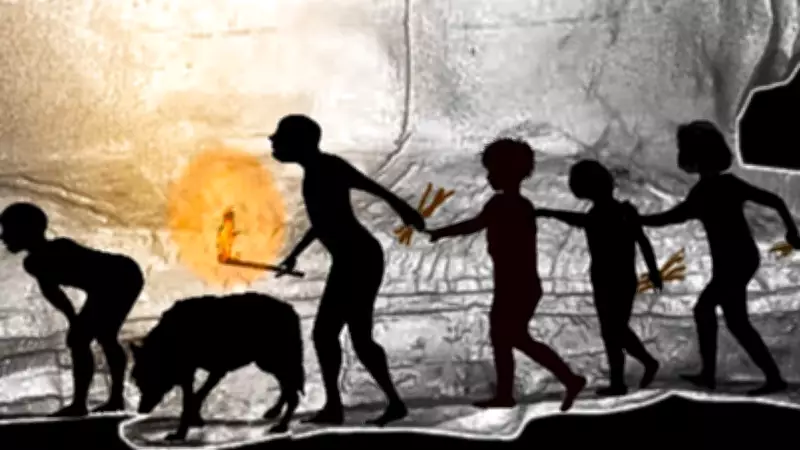
One of the more revealing aspects of the reconstruction is how lighting and group structure interacted. Researchers found that the most stable configuration placed one light source at the front of the group and another at the rear. This setup reduced disorientation in winding passages and helped maintain spatial awareness in near-total darkness. The middle members of the group relied on physical contact, typically a hand on the shoulder of the person ahead, to maintain formation. That detail matters because it reframes cave travel as a tactile experience as much as a visual one. It also complicates a common assumption that prehistoric lighting was primarily about visibility. In environments like Bàsura, lighting also functioned as a social coordination tool, regulating spacing, pace, and group cohesion.
What Pollen and Charcoal Actually Reveal About Fuel Choices
Sediment analysis adds another layer to the story. Pollen samples indicate a landscape dominated by steppe vegetation with scattered pine forests, consistent with cold and dry conditions at the end of the Ice Age. Pine species, especially Scots pine, were present but not overwhelmingly dominant. Interestingly, much of the pollen found inside the cave may not have been carried in directly by humans. Instead, cave bears likely played a major role. Bears moving between outdoor environments and hibernation sites transported pollen on their fur, effectively acting as biological carriers of environmental data into the cave system. The charcoal evidence, however, is harder to misattribute. Its distribution patterns, small fragments beneath wall marks, and clustered residues match the experimental burning tests closely. That strengthens the case that humans were actively producing and managing fire inside confined underground spaces.
A Misconception About Prehistoric Torches Still Lingers
The intuitive model of cave exploration often borrows from later historical imagery: large flaming torches, dramatic light contrasts, and relatively simple movement through dark corridors. The evidence suggests a more constrained reality where light sources were small, short-lived, and carefully allocated. Instead of dramatic illumination, prehistoric travelers likely operated within a narrow corridor of visibility, just enough to avoid obstacles, not enough to fully reveal the cave. That distinction changes the interpretation of cave art sites and footprint trails elsewhere in Europe. It suggests that movement underground may have been slower, more deliberate, and far more dependent on group coordination than previously assumed.