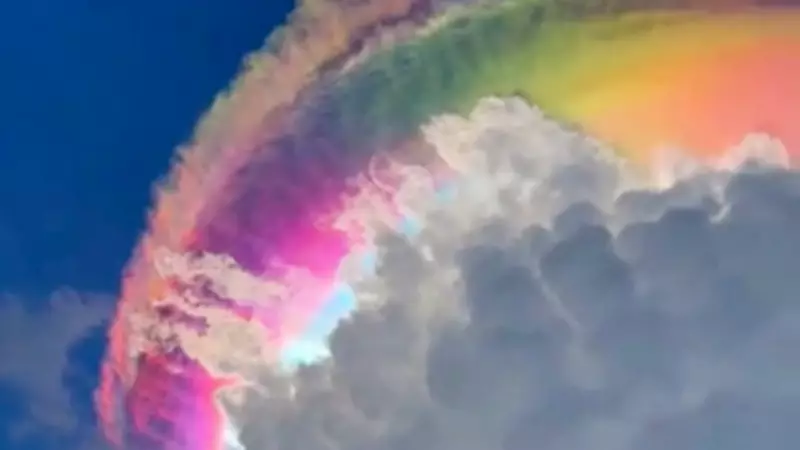
Residents in Jonggol, Indonesia, were left stunned after vibrant “rainbow clouds” lit up the sky in videos that quickly went viral across social media. The unusual clouds displayed swirling bands of pink, green, blue and yellow, leading some viewers to suspect the footage had been created using artificial intelligence.
Scientists, however, say the phenomenon was completely real and is known as cloud iridescence, a rare optical effect caused when sunlight interacts with tiny water droplets or ice crystals inside thin clouds. Atmospheric experts say the colourful display highlights how Earth’s atmosphere can sometimes create visuals that appear almost digitally generated.
What scientists say caused the rainbow clouds in Indonesia
Scientists explain that cloud iridescence occurs when sunlight is diffracted by extremely small water droplets or tiny ice crystals suspended in clouds. Diffraction happens when light bends and spreads after encountering particles similar in size to the wavelength of visible light. This process separates sunlight into multiple colours, creating the striking pastel shades and rainbow-like patterns seen across the clouds.

Atmospheric optics researcher Joseph A. Shaw, who has studied iridescence and related sky phenomena, has explained that these colours form most clearly when cloud particles are unusually small and relatively uniform in size. According to researchers, the Indonesian display likely formed under a very specific combination of thin clouds, stable atmospheric conditions and the correct angle of sunlight.
Why the phenomenon is relatively rare
Scientists say cloud iridescence does not appear frequently because several atmospheric conditions must align at the same time. The clouds need to be thin enough for sunlight to pass through while also containing droplets or ice crystals that are nearly identical in size. Even small differences between particles can weaken the colours or prevent the phenomenon from appearing altogether.
Researchers also note that the position of the Sun and the observer’s viewing angle are extremely important. Newly forming clouds and semi-transparent clouds are more likely to produce vivid iridescence because their particles tend to be more uniform.
The difference between rainbow clouds and real rainbows
Despite the popular nickname, rainbow clouds are not technically rainbows. Traditional rainbows form when sunlight is refracted, reflected and dispersed inside raindrops after rainfall. Cloud iridescence, on the other hand, is mainly caused by diffraction and interference involving microscopic droplets or ice crystals.
Scientists say iridescent clouds usually appear much closer to the Sun and often produce softer, less structured colour patterns than ordinary rainbows. Instead of forming a large arc across the sky, the colours spread unevenly across sections of cloud.
Which clouds can produce iridescence
Researchers say cloud iridescence is commonly seen in altocumulus, cirrocumulus, cirrus and lenticular clouds. Lenticular clouds are especially known for dramatic iridescent displays because their smooth shape and stable airflow often allow highly uniform droplets to form.
These clouds typically develop at high altitudes where atmospheric conditions remain relatively stable, making it easier for sunlight to interact consistently with suspended particles.
Why many people thought the videos were AI-generated
The Indonesian videos spread during a period of growing skepticism around viral visuals because AI-generated imagery has become increasingly realistic. Many viewers online questioned whether the footage was authentic because the colours appeared unusually vivid and almost digitally enhanced.
Scientists say the reaction reflects how modern audiences are becoming more cautious about extraordinary visuals circulating online. However, cloud iridescence has been documented scientifically for decades and photographed around the world long before generative AI existed.

Similar colourful sky phenomena seen on Earth and Mars
Cloud iridescence belongs to a broader family of atmospheric optical effects that includes circumhorizontal arcs, polar stratospheric clouds, glories and noctilucent clouds. All of these phenomena are influenced by the interaction of sunlight with water droplets or ice crystals in the atmosphere.
Scientists have even observed similar colourful cloud phenomena on Mars. NASA missions have photographed iridescent noctilucent clouds in the Martian atmosphere, where frozen carbon dioxide particles can scatter sunlight in unusual ways. Researchers say these displays demonstrate how atmospheric physics can create spectacular visual effects both on Earth and elsewhere in the Solar System.
About the Author: The TOI Science Desk stands as an inquisitive team of journalists, ceaselessly delving into the realms of discovery to curate a captivating collection of news, features, and articles from the vast and ever-evolving world of science for the readers of The Times of India. Consider us your scientific companion, delivering a daily dose of wonder and enlightenment. Whether it's the intricacies of genetic engineering, the marvels of space exploration, or the latest in artificial intelligence, the TOI Science Desk ensures you stay connected to the pulse of the scientific world. At the TOI Science Desk, we are not just reporters; we are storytellers of scientific narratives. We are committed to demystifying the intricacies of science, making it accessible and engaging for readers of all backgrounds. Join us as we craft knowledge with precision and passion, bringing you on a journey where the mysteries of the universe unfold with every word.