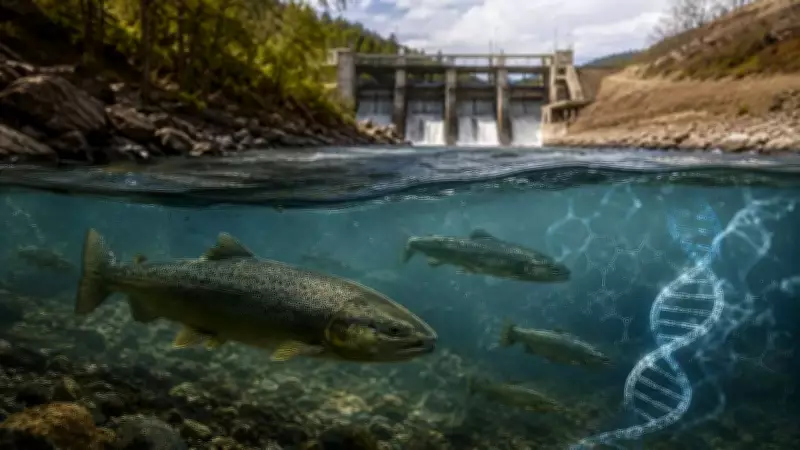
For years, river restoration has followed a familiar script: remove barriers where possible, reconnect fragmented waterways, and recreate flow patterns resembling those before large-scale human intervention. The assumption has largely been that healthier rivers will naturally support healthier fish populations.
Yet rivers altered by dams, weirs, and water regulation are not simply damaged ecosystems waiting to be repaired. Many have been transformed for decades, sometimes centuries. Fish living in those waters have been exposed to entirely different conditions from those faced by previous generations. According to a study titled "Eco-Evo-Hydraulics: Integrating Fish Evolution Into Ecohydraulics for Conservation," conservation efforts may be missing an important reality: fish populations are adapting to the environments people have created. The authors argue that understanding those evolutionary changes could become an essential part of future river management.
How Human-Made Rivers Are Changing Fish Populations
Evolution is often associated with timescales far beyond human lifetimes. The review points to growing evidence that some freshwater fish can respond much more quickly when environmental pressures are strong enough. In regulated rivers, altered flows, restricted movement, and changing habitats can favor certain traits over others. Atlantic salmon in Norway, for instance, experienced a substantial reduction in body size over roughly three decades following river regulation, with genetic changes linked to the shift. In the United States, blacktail shiners displayed measurable changes in body shape soon after dam construction transformed their habitat. These observations suggest that fish are not simply enduring altered rivers—they are adjusting to them.

Why Restoring Rivers May No Longer Be Enough
Traditional river conservation has largely centered on habitat: better connectivity, suitable spawning grounds, and more natural flow conditions have formed the backbone of many restoration projects. According to the review, that approach becomes harder to apply in a world where climate patterns are shifting and rivers continue to experience multiple forms of human pressure. In many watersheds, there is no clear route back to a historical baseline. Conditions that existed decades ago may not be achievable or even relevant in the future. The authors suggest that conservation should not focus solely on recreating past environments. It should also consider whether fish populations possess the genetic diversity and adaptive capacity needed to cope with future changes.
Hydraulic structures are usually viewed through their physical effects: they interrupt migration routes, alter water velocity, and modify sediment movement throughout a river system. As per the study, when populations become separated by barriers, gene flow can decline. Over time, isolated groups may become genetically distinct. Certain traits may become more common because they offer advantages under new environmental conditions created by regulation and fragmentation. This means that engineering projects can influence not only where fish live but also how populations develop genetically across generations.
How Changing Fish Populations Can Alter River Processes
An intriguing aspect of the proposed framework is that the relationship is not one-sided. Rivers influence fish, but fish can also influence rivers. Some species modify riverbeds while feeding or building nests. Salmon, for example, move gravel when preparing spawning sites. The amount of sediment they can displace is linked to body size. If river regulation favors smaller individuals over time, the way sediment is redistributed within a river could also change. The authors describe these interactions as hydro-evolutionary feedbacks: environmental conditions shape evolutionary responses, while evolutionary changes may gradually alter physical processes within river systems.

What the Future of River Conservation Could Look Like
Rather than abandoning restoration, the researchers argue for expanding its scope. Habitat improvement remains important, but it may need to be paired with a better understanding of genetics and evolutionary potential. According to the study, greater use of genetic monitoring alongside traditional ecological surveys is needed. Tracking genetic diversity could help identify populations that are becoming isolated or losing their ability to adapt. It could also provide insight into how species are responding to altered flow regimes, rising temperatures, and other long-term pressures. By combining ecology, hydrology, and evolutionary biology, the authors suggest a broader framework for conservation—one that recognizes rivers as changing systems and fish as active participants in that change rather than passive inhabitants of restored habitats.