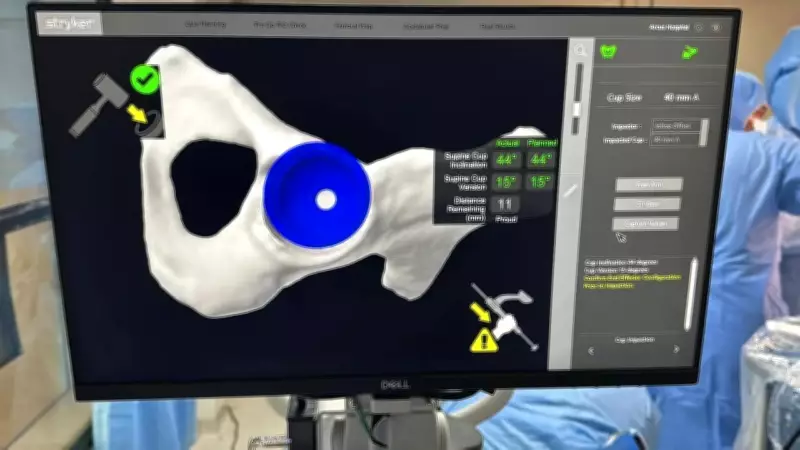
A 40-year-old businessman from Pune, who endured a traumatic hip replacement failure two years ago, has successfully undergone a robotic-assisted hip replacement surgery at a city hospital. The patient, weighing 124 kg with a BMI of 41, had previously received a ceramic-on-ceramic hip implant that shattered within eight days, leaving him bedridden for three weeks with a 36-cm scar and requiring multiple blood transfusions.
Failed Surgery and Trauma
The patient initially underwent a left-side total hip replacement elsewhere. Dr Rohit Luthra, orthopaedic surgeon at Arcus Hospital, explained that the ceramic-on-ceramic liner could not withstand the patient's weight, breaking just eight days post-surgery. A corrective surgery using a poly liner was performed, but the physical and emotional damage had already set in, leaving the patient deeply traumatized.
Robotic Precision for Complex Case
When the patient needed his right hip replaced, Dr Luthra employed CT-based robotic planning and a robotic-assisted direct anterior approach (DAA) with an X3 liner. This technology creates a virtual 3D model of the hip, enabling precise implant sizing and placement. The DAA spares muscles and tendons, unlike traditional posterior techniques that cut through muscles, leading to significant strength loss and higher dislocation risks, especially in patients with a BMI over 35.

Immediate Results and Recovery
The outcomes were remarkable. The previous surgery left a 36-cm scar, while the robotic procedure required only an 8-cm incision. Within four hours, the patient was walking; in three days, he discarded his walker; and within 15 days, he returned to work. The patient reported minimal pain and no need for blood transfusions, contrasting sharply with his previous nightmare.
Anaesthetic Advantages
Dr Rajesh Kothavale, the anaesthetist, highlighted that the DAA allows the patient to remain supine, simplifying airway management in heavy patients. Traditional lateral positioning can complicate ventilation in individuals weighing 124 kg, but the supine position made the procedure smooth.
Material Selection Critical
Dr Luthra stressed that implant material must match patient weight. Ceramic-on-ceramic liners are prone to shattering under high joint reactive forces in obese individuals. This time, a poly liner inside a ceramic implant was used to reduce friction and enhance durability.
Expert Validation
Senior orthopaedic surgeon Dr Ramkinkar Jha confirmed that ceramic-on-ceramic implants carry fracture risks in obese patients. He emphasized that muscle preservation and precision robotics are essential for such complex cases, improving long-term outcomes and easing surgical challenges.