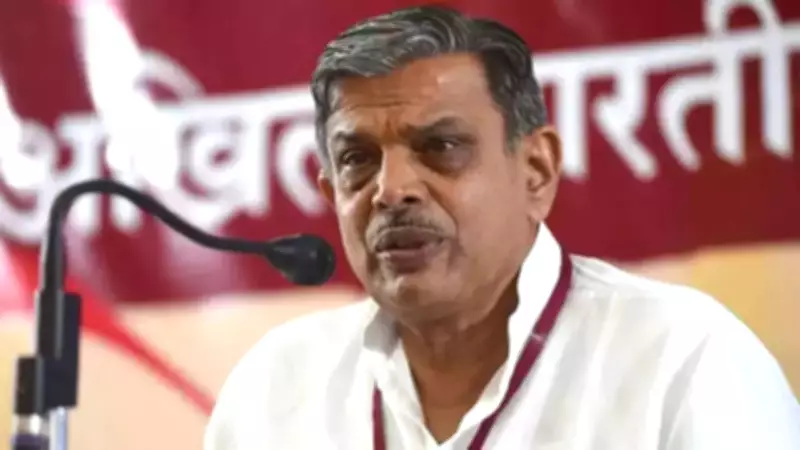
RSS General Secretary Flags AI Risks to Social Equality at Stanford Conference
As global debates over the societal impacts of artificial intelligence intensify, RSS general secretary Dattatreya Hosabale raised a critical alarm on Friday, warning that technology-driven growth, if left unregulated, could exacerbate inequalities and fuel social fragmentation. Speaking at the Thrive 2026 conference at Stanford University, Hosabale emphasized that innovation must not become a source of instability, but rather a force for inclusive progress.
Technology and Inequality: A Growing Concern
Hosabale articulated that scientific advancements should be assessed not merely by economic metrics but through a holistic framework encompassing "economy, equality, and ethics." He pointedly noted, "Where technology advances, society tends to become more unequal," linking disparities in access to education and technology with widening gaps in income, opportunity, and overall quality of life. This perspective underscores a broader critique of how rapid tech adoption can marginalize vulnerable populations.
Indian Civilizational Thought as a Guiding Framework
Participating in a panel titled "Science, Knowledge Systems and Civilizational Leadership," alongside experts like Ben Olsen of Responsible AI at Microsoft and Meta, Dr. William Hurlbut from Stanford's Neuroscience Institute, and moderator Bill Drexel of the Hudson Institute, Hosabale argued that Indian traditions offer a unique model where science and spirituality coexist harmoniously. He explained, "There is no segregation between the spiritual and the secular in spiritual knowledge," highlighting traditions rooted in both sensory and super-sensory inquiry. Systems such as yoga, he added, reflect structured studies of human anatomy, mind sciences, and behavior.

Geopolitical and Societal Challenges Highlighted
Hosabale also addressed pressing global issues, stating that "today's world is also passing through very critical times," citing religious conflicts, power imbalances, and weakening social cohesion. He warned against extremism and the erosion of family structures, asserting, "If families are healthy, the society is healthy, nation is healthy." This call for social stability ties into his broader message on the need for balanced governance in technological development.
Advice to Indian Diaspora and Knowledge Preservation
On the role of the Indian diaspora, Hosabale urged overseas communities to prioritize loyalty to their host nations while maintaining cultural ties with India, framing this within the concept of "Vasudhaiva Kutumbakam" (the world is one family). He cautioned that poor education could distort scientific understanding, noting, "If traditional knowledge is not properly understood, all those scientific inquiries of the past will be concluded as only superstitions." He also highlighted early Indian achievements in town planning, university systems, and civil engineering, advocating for the revival of indigenous knowledge.
Call for Sustainable and Ethical Innovation
Concluding his remarks, Hosabale called for technological growth that does not compromise environmental balance, urging policymakers to align innovation with social stability and sustainability. His speech serves as a timely reminder for global leaders to integrate ethical considerations into tech policies, ensuring that progress benefits all segments of society equitably.