For millions of years, dinosaurs dominated the Earth with their immense size and top position across ancient ecosystems. They are often imagined as fearsome top predators, intimidating every other creature. However, it is surprising to learn that even the largest prehistoric animals were not entirely safe. During the Late Cretaceous period, young dinosaurs and their eggs were particularly vulnerable, attracting various carnivorous creatures seeking easy meals.
Fossil Discoveries Reveal Ancient Predator-Prey Relationships
Over the past decade, numerous fossil discoveries have helped scientists understand these predator-prey dynamics, shedding light on how ancient ecosystems functioned long before humans appeared. Among the most intriguing findings is a prehistoric snake species discovered in India that may have preyed on baby dinosaurs. While this might seem improbable, a study published in the Public Library of Science (PLOS) provides compelling evidence.
Meet Sanajeh indicus: The Snake That Hunted Dinosaur Hatchlings
Unlike modern giant snakes that swallow large prey whole, this ancient reptile appears to have used ambush and opportunistic tactics. Its fossilized remains were found near dinosaur eggs and hatchlings, offering rare evidence of its feeding behavior preserved in time. Such discoveries are extremely uncommon because snake skeletons are fragile and rarely preserved intact in the fossil record.

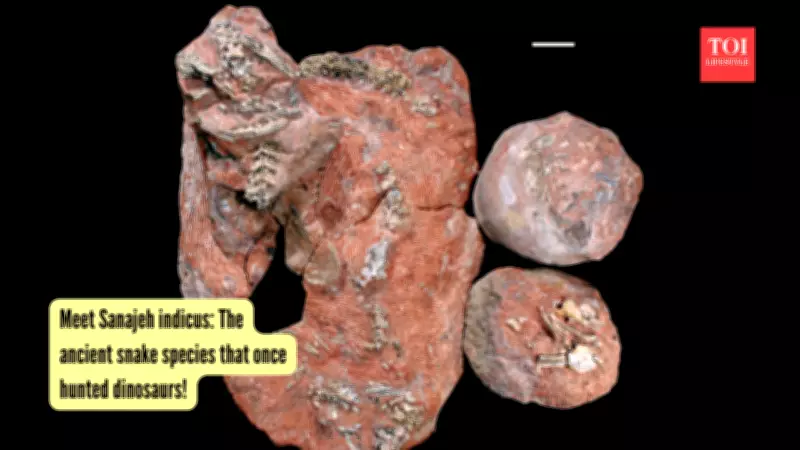
Named Sanajeh indicus, this prehistoric snake lived approximately 67 million years ago during the Late Cretaceous period in what is now western India. The species gained global attention when scientists discovered its fossil coiled around sauropod dinosaur eggs and a hatchling. This finding suggests that ancient snakes preyed on newly hatched dinosaurs and possibly raided nests for food.
The Fossil's Journey: From Discovery to Recognition
The fossil was originally discovered in 1984 by Indian paleontologist Dhananjay Mohabey in Gujarat's Lameta Formation. However, according to the study, the fossil's significance became apparent years later when paleontologist Jeffrey Wilson re-examined the specimen alongside Mohabey. Their research yielded surprising results, revealing the articulated remains of a snake coiled near sauropod eggs and a hatchling. This made it one of the rarest 'behavioral' fossil discoveries involving snakes.
What the Name Means
The name Sanajeh means 'ancient gape,' referring to the snake's feeding anatomy. Unlike modern egg-eating snakes that can stretch their jaws widely to swallow eggs whole, Sanajeh indicus likely had a more limited jaw structure. The study noted that the snake 'was incapable of ingesting large prey whole,' meaning it may have attacked hatchlings instead of swallowing eggs intact.
Why Was the Snake Coiled Near the Eggs?
Scientists believe the snake probably waited near nesting grounds for vulnerable baby dinosaurs to hatch. Sauropods laid large communal nests containing many eggs, making them an ideal feeding opportunity for predators. According to the research, the fossil association 'provides direct evidence of snake predation on sauropod hatchlings.'
This discovery not only highlights the complex interactions within ancient ecosystems but also underscores the importance of re-examining historical fossil collections. The story of Sanajeh indicus continues to captivate scientists and the public alike, offering a glimpse into a world where even the mightiest dinosaurs faced threats from unexpected predators.