

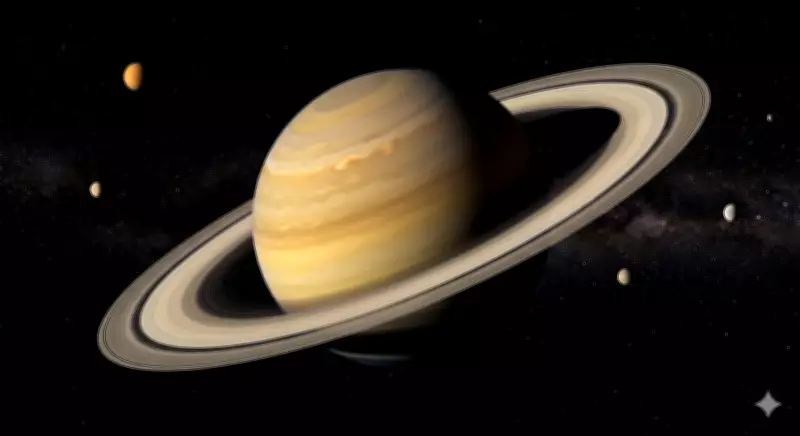
Saturn's Mysterious Spin Solved: NASA and Webb Telescope Crack the Code
For decades, the rotation speed of Saturn has baffled scientists, appearing to change unpredictably and defying established physical laws. Days on the gas giant seemed to vary in length, creating a scientific conundrum that challenged our understanding of planetary dynamics. However, recent breakthroughs from NASA's Cassini mission and observations by the James Webb Space Telescope have finally unveiled the truth behind this enigma, revealing it to be a complex natural illusion.
The Puzzling Observations That Started It All
The mystery dates back to 2004 when NASA's Cassini satellite first detected irregularities in Saturn's rotation. Measurements showed the planet's spin rate fluctuating, with days appearing to lengthen or shorten by several minutes—a phenomenon that should be impossible for a stable celestial body. Experts were left scratching their heads, describing the situation as "something strange was going on with the rotation rate of Saturn." The inconsistency in data only deepened the puzzle, as different observations failed to align.
The core issue stemmed from Saturn's nature as a gas giant, lacking a solid surface to anchor rotation measurements. Scientists relied on indirect methods, such as monitoring radio emissions, but these proved unreliable, leading to conflicting results and widespread confusion in the astronomical community.

Unraveling the Illusion: Winds, Auroras, and Magnetic Fields
New studies have conclusively shown that Saturn's rotation has remained constant all along. The perceived variability was an illusion crafted by powerful atmospheric phenomena. Temperature gradients in Saturn's upper atmosphere generate intense winds, which in turn influence auroral activity. These auroras interact with the planet's magnetic field, altering the radio emissions that scientists use to estimate rotation speed.
Researchers emphasized that the recorded radio signals were not linked to Saturn's core rotation at all. As one team noted, "it took our new observations from the Keck Observatory to finally provide direct evidence confirming the link" between winds and the misleading data. This revelation clarifies that the mystery was not about a changing spin but about misinterpreted signals from complex atmospheric dynamics.
Why This Discovery Matters for Planetary Science
Beyond being a landmark scientific achievement, this finding has profound implications for the study of planets. Understanding Saturn's true rotation enables more accurate analysis of its internal structure, magnetosphere, and atmospheric behavior. It highlights the unique challenges of investigating gas giants, where phenomena like winds and auroras can obscure fundamental properties.
The discovery also underscores the limitations of past equipment and methods, showing how natural complexities on Saturn made it difficult to discern reality. Moving forward, these insights offer a valuable opportunity to refine techniques for exploring not only Saturn but also other distant planets, enhancing our ability to decode the mysteries of the universe.






