When Satya Nadella became Microsoft's CEO on February 4, 2014, the company was facing a quiet crisis. It was not the dramatic, headline-grabbing kind, but a slow, creeping decline that is often more dangerous. The PC market was shrinking, mobile technology had already taken over, and Microsoft had largely missed the boat. Apple and Google had established dominance. The stock had remained flat for over a decade. Internally, the culture had become competitive in unhealthy ways, with employees protecting their turf rather than building innovative solutions.
Nadella's First Email: A Direct Message to 100,000 Employees
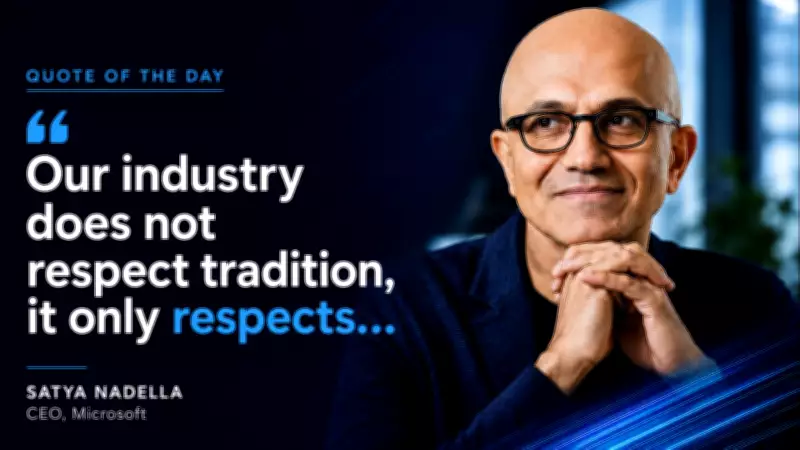
Nadella's initial email to all employees could have been a self-congratulatory message wrapped in humility, as many CEO introductions are. Instead, he wrote something so direct that it remains relevant eleven years later. Eleven words into the email to a company of 100,000, he stated: "Our industry does not respect tradition—it only respects innovation."
He was not speaking abstractly. He was telling over 100,000 employees, on his first day, that nostalgia for Microsoft's past—the dominance of Windows, the glory years of Office, the era of a PC on every desk—was not a viable strategy for the future. Reverence for the past had a ceiling, and they were hitting it. It was a gentle line, but also a warning.

When Tradition Becomes a Risk
Tradition is not inherently bad. It carries institutional knowledge, proven systems, and things that work. The problem arises when tradition becomes an excuse, when "this is how we've always done it" quietly replaces "is this still the right way to do it?" This shift is subtle and common. Print media clung to its old revenue model long after it became obsolete. Video rental chains saw streaming coming but bet on their physical stores anyway. Taxi companies had a decade of warning before ride-hailing disrupted them. None of these industries lacked intelligent people; they simply trusted their track record more than the signals around them. Nadella was identifying that trap before Microsoft fell into it completely.
Nadella Introduced Himself as a Learner, Not a Fixer
What makes the quote even more interesting is the context of who said it. Nadella did not introduce himself as a turnaround artist or a hard-charging strategist. He described himself as someone who buys more books than he can finish and signs up for more online courses than he can complete. He emphasized that curiosity was central to how he operated. This is not incidental. Real innovation requires staying genuinely open to being wrong about what you know—a discomfort that is especially challenging inside a company that had been right about so many things for so long.
Under his leadership, Microsoft embraced cloud computing through Azure, became a key player in AI, acquired GitHub and LinkedIn, and rebuilt its internal culture around collaboration rather than competition. The stock price in early 2014 hovered around $37. The rest is well-documented history.
The Tough Question Nadella Asks: Are You Still Building or Just Protecting?
You do not have to be in tech for this lesson to apply. The implicit question Nadella was asking—are we protecting what we have built, or are we still building?—is relevant for any team, company, or individual. Tradition earns its place by being tested against current needs. When it fails that test, it is just habit with a better reputation. Nadella asked that question publicly, on day one, in writing. That is significant.
Read the Full Letter from Microsoft CEO Satya Nadella
From: Satya Nadella
To: All Employees
Date: Feb. 4, 2014
Subject: RE: Satya Nadella – Microsoft's New CEO
Today is a very humbling day for me. It reminds me of my very first day at Microsoft, 22 years ago. Like you, I had a choice about where to come to work. I came here because I believed Microsoft was the best company in the world. I saw then how clearly we empower people to do magical things with our creations and ultimately make the world a better place. I knew there was no better company to join if I wanted to make a difference. This is the very same inspiration that continues to drive me today.

It is an incredible honor for me to lead and serve this great company of ours. Steve and Bill have taken it from an idea to one of the greatest and most universally admired companies in the world. I've been fortunate to work closely with both Bill and Steve in my different roles at Microsoft, and as I step in as CEO, I've asked Bill to devote additional time to the company, focused on technology and products. I'm also looking forward to working with John Thompson as our new Chairman of the Board.
While we have seen great success, we are hungry to do more. Our industry does not respect tradition—it only respects innovation. This is a critical time for the industry and for Microsoft. Make no mistake, we are headed for greater places—as technology evolves and we evolve with and ahead of it. Our job is to ensure that Microsoft thrives in a mobile and cloud-first world.
As we start a new phase of our journey together, I wanted to share some background on myself and what inspires and motivates me.
Who Am I?
I am 46. I've been married for 22 years and we have 3 kids. And like anyone else, a lot of what I do and how I think has been shaped by my family and my overall life experiences. Many who know me say I am also defined by my curiosity and thirst for learning. I buy more books than I can finish. I sign up for more online courses than I can complete. I fundamentally believe that if you are not learning new things, you stop doing great and useful things. So family, curiosity and hunger for knowledge all define me.
Why Am I Here?
I am here for the same reason I think most people join Microsoft—to change the world through technology that empowers people to do amazing things. I know it can sound hyperbolic—and yet it's true. We have done it, we're doing it today, and we are the team that will do it again.
I believe over the next decade computing will become even more ubiquitous and intelligence will become ambient. The coevolution of software and new hardware form factors will intermediate and digitize—many of the things we do and experience in business, life and our world. This will be made possible by an ever-growing network of connected devices, incredible computing capacity from the cloud, insights from big data, and intelligence from machine learning.
This is a software-powered world. It will better connect us to our friends and families and help us see, express, and share our world in ways never before possible. It will enable businesses to engage customers in more meaningful ways. I am here because we have unparalleled capability to make an impact.
Why Are We Here?
In our early history, our mission was about the PC on every desk and home, a goal we have mostly achieved in the developed world. Today we're focused on a broader range of devices. While the deal is not yet complete, we will welcome to our family Nokia devices and services and the new mobile capabilities they bring us.
As we look forward, we must zero in on what Microsoft can uniquely contribute to the world. The opportunity ahead will require us to reimagine a lot of what we have done in the past for a mobile and cloud-first world, and do new things. We are the only ones who can harness the power of software and deliver it through devices and services that truly empower every individual and every organization. We are the only company with history and continued focus in building platforms and ecosystems that create broad opportunity.
Qi Lu captured it well in a recent meeting when he said that Microsoft uniquely empowers people to "do more." This doesn't mean that we need to do more things, but that the work we do empowers the world to do more of what they care about—get stuff done, have fun, communicate and accomplish great things. This is the core of who we are, and driving this core value in all that we do—be it the cloud or device experiences—is why we are here.
What Do We Do Next?
To paraphrase a quote from Oscar Wilde—we need to believe in the impossible and remove the improbable. This starts with clarity of purpose and sense of mission that will lead us to imagine the impossible and deliver it. We need to prioritize innovation that is centered on our core value of empowering users and organizations to "do more." We have picked a set of high-value activities as part of our One Microsoft strategy. And with every service and device launch going forward we need to bring more innovation to bear around these scenarios.
Next, every one of us needs to do our best work, lead and help drive cultural change. We sometimes underestimate what we each can do to make things happen and overestimate what others need to do to move us forward. We must change this.
Finally, I truly believe that each of us must find meaning in our work. The best work happens when you know that it's not just work, but something that will improve other people's lives. This is the opportunity that drives each of us at this company.
Many companies aspire to change the world. But very few have all the elements required: talent, resources, and perseverance. Microsoft has proven that it has all three in abundance. And as the new CEO, I can't ask for a better foundation.
Let's build on this foundation together.
Satya
About the Author: TOI Tech Desk
The TOI Tech Desk is a dedicated team of journalists committed to delivering the latest and most relevant news from the world of technology to readers of The Times of India. TOI Tech Desk's news coverage spans a wide spectrum across gadget launches, gadget reviews, trends, in-depth analysis, exclusive reports and breaking stories that impact technology and the digital universe. Be it how-tos or the latest happenings in AI, cybersecurity, personal gadgets, platforms like WhatsApp, Instagram, Facebook and more; TOI Tech Desk brings the news with accuracy and authenticity.