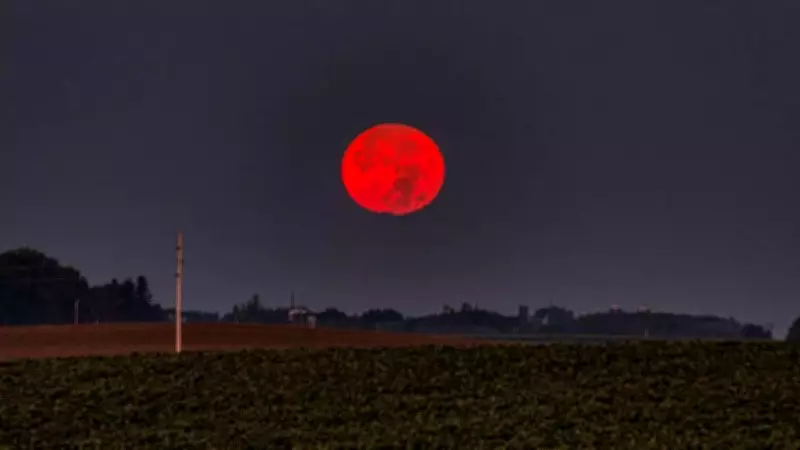
The Science of the Blood Moon: Unraveling the Mystery of Lunar Eclipses
It can be a truly dramatic spectacle when the Moon gradually darkens and transforms into a deep, crimson hue. For centuries, this awe-inspiring sight has evoked fear and superstition among various cultures, often interpreted as an ominous sign of impending doom. However, modern science provides a clear and fascinating explanation, demystifying this celestial phenomenon.
What Is a Total Lunar Eclipse?
A lunar eclipse occurs when Earth positions itself directly between the Sun and the Moon, obstructing sunlight from reaching the lunar surface. According to NASA, this precise alignment can only happen during a full Moon phase. There are three primary types of lunar eclipses:
- Penumbral lunar eclipse
- Partial lunar eclipse
- Total lunar eclipse
The Blood Moon phenomenon exclusively manifests during a total lunar eclipse, when the Moon fully enters the darkest region of Earth's shadow, known as the umbra. Lunar eclipses typically occur zero to three times annually, though rare instances may yield more, but not all are total eclipses.

How Earth Blocks Sunlight During an Eclipse
When Earth aligns between the Sun and the Moon, it casts an extensive shadow into space, comprising two key components:
- Penumbral shadow: The outer, lighter shadow
- Umbra: The inner, darkest shadow
During a total lunar eclipse, the Moon traverses the umbra, where direct sunlight is completely blocked. Logically, one might anticipate the Moon to vanish into darkness, but instead, it glows with a striking red or orange tint. The European Space Agency attributes this to Earth's atmosphere bending and filtering sunlight before it illuminates the Moon.
The Science Behind the Moon's Red Hue
Sunlight appears white but consists of a spectrum of colors with varying wavelengths. Blue and violet light have shorter wavelengths, while red and orange light possess longer wavelengths. As sunlight penetrates Earth's atmosphere, shorter wavelengths scatter in all directions through a process called Rayleigh scattering, which also explains why the sky appears blue during daytime.
NASA notes that blue and violet light scatter more readily upon encountering air molecules, whereas red and orange light, with their longer wavelengths, traverse the atmosphere more efficiently. During a total lunar eclipse, sunlight passes through the periphery of Earth's atmosphere before reaching the Moon. As it navigates this dense atmospheric layer:
- Blue light is dispersed away
- Red and orange light continue forward
- Earth's atmosphere acts as a lens, slightly bending the red light
By the time this filtered light strikes the Moon, most blue light has been eliminated, leaving predominantly red light to reflect off the lunar surface and return to Earth, creating the iconic red appearance.
Why Is It Called a "Blood Moon"?
The term "Blood Moon" is not scientific but a popular descriptor for the reddish coloration observed during total lunar eclipses. Reports indicate that the exact shade can vary significantly, ranging from a coppery orange to a deep red or even dark brown. This variation primarily depends on atmospheric conditions at the time of the eclipse.
Factors Influencing the Intensity of Red Color
Not all Blood Moons exhibit the same vividness. Some appear bright orange, while others look dark red or greyish. NASA explains that this discrepancy stems from Earth's atmospheric conditions, influenced by factors such as:
- Dust in the atmosphere
- Volcanic ash
- Wildfire smoke
- Air pollution
Major events like volcanic eruptions or extensive wildfires introduce additional particles into the air, which can alter sunlight filtration, potentially darkening the Moon's appearance. Thus, a total lunar eclipse can serve as a real-time indicator of Earth's atmospheric state.

The View from the Moon During an Eclipse
If an observer were stationed on the Moon during a total lunar eclipse, the perspective would be remarkably different. They would witness Earth obscuring the Sun, appearing as a dark circle encircled by a glowing red ring—the planet's atmosphere. This red glow results from sunlight passing through and bending around Earth, illuminating the Moon's surface with a crimson light during the eclipse.
A Celestial Light Show Explained by Physics
A total lunar eclipse, while not exceedingly rare, remains a captivating event that merges celestial alignment, shadow geometry, and atmospheric physics into a single visible spectacle. In essence:
- Earth blocks direct sunlight
- Earth's atmosphere scatters blue light
- Red light bends and reaches the Moon
- The Moon reflects that red light back to observers on Earth
There is no supernatural mystery involved; the red hue of a Blood Moon is a direct consequence of light scattering and atmospheric filtering. The next time the Moon turns red, it should not be perceived as a harbinger of danger but as a reminder of how sunlight, when filtered through our planet's atmosphere, can produce one of the most dramatic visual displays in the night sky.