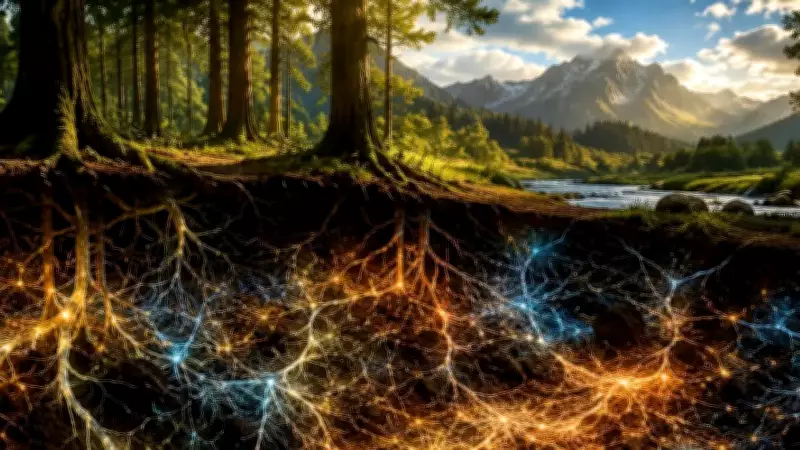
Beneath forests, grasslands, and even garden soil lies an extraordinary hidden world. Scientists have now mapped a vast underground network of microscopic fungi stretching an estimated 110 quadrillion kilometers across Earth's topsoil, a distance so immense it could reach the Sun nearly a billion times. The discovery has drawn comparisons to Astrophage from Andy Weir's novel Project Hail Mary, though researchers emphasize this is metaphorical. These ancient fungal networks quietly support much of life on Earth, aiding plant growth, storing carbon, and maintaining ecosystem health.
Inside Earth's Hidden Giant Fungal Network
The discovery comes from a major international study led by researchers associated with the Society for the Protection of Underground Networks (SPUN). Using over 16,000 soil samples and advanced computer modeling, scientists created the most detailed global map yet of arbuscular mycorrhizal fungi, a group that lives in partnership with plant roots. The study revealed that these microscopic fungal threads, known as hyphae, collectively stretch around 110 quadrillion kilometers through world soils. Although invisible to the naked eye, they form one of the largest biological systems on Earth. Importantly, this figure represents the combined length of countless fungal networks spread across ecosystems, not a single giant organism.
Why Compare It to Project Hail Mary?
The comparison stems from Project Hail Mary, where Astrophage is a microscopic lifeform storing enormous energy. The mapped fungal networks are not alien and do not behave like Astrophage, but both involve hidden biological systems operating on an immense scale. Like the fictional organism, these fungi move resources across vast networks, support larger ecosystems, and have influence far greater than their size suggests. In reality, these fungi have performed their role for hundreds of millions of years.

What Are Arbuscular Mycorrhizal Fungi?
Arbuscular mycorrhizal (AM) fungi form mutually beneficial relationships with about 70% of all land plants. Plants produce sugars through photosynthesis and share energy with fungi, which in turn help plants absorb water and nutrients like phosphorus and nitrogen. The fungi extend beyond roots, acting as an underground extension of the root system, allowing plants to access otherwise unreachable resources. Scientists believe these fungi helped plants colonize land roughly 475 million years ago.
The Hidden 'Wood Wide Web' Beneath Our Feet
Researchers often call these systems the "wood wide web" because they connect plants through vast underground networks. Fungal threads can link multiple plants, allowing nutrients, water, and chemical signals to move through soil. Some studies suggest plants use these networks to share resources or send distress signals when threatened. While scientists debate the extent of information transfer, there is broad agreement that these networks are fundamental to ecosystem health. Without them, many plants would struggle to survive.
Why the Discovery Matters for Climate Change
One key finding concerns carbon storage. Earth's topsoils contain approximately 300 megatons of carbon locked inside these fungal networks, roughly four to six times the total mass of all humans. The fungi also transport carbon-rich compounds from plants into soil, helping sequester up to one billion metric tons of carbon yearly, making them a natural ally against climate change. Carbon stored underground is less likely to enter the atmosphere as carbon dioxide, helping regulate Earth's climate.
Where Are These Networks Most Abundant?
The study found densest fungal networks in natural ecosystems like grasslands, wetlands, and floodplains. Large wetland systems, including Florida's Everglades and South Sudan's Sudd wetlands, emerged as important hotspots, supporting rich fungal communities that contribute to biodiversity, soil health, and carbon storage. Protecting such ecosystems could have benefits beyond wildlife preservation, as their underground fungal networks provide critical environmental services.

Why Scientists Are Concerned About Agriculture
The findings also reveal signs of decline. Intensively farmed croplands contain significantly fewer fungal networks than nearby natural ecosystems. Practices like deep tilling, excessive fertilizer use, and soil disturbance damage fungal communities. Fungal concentrations in agricultural land can be nearly 50% lower than in undisturbed environments. This loss may make crops more dependent on synthetic fertilizers and less resilient to drought and other stresses.
What Could This Mean for the Future?
Scientists believe the new map will help identify areas needing protection and restoration. Protecting these hidden ecosystems could improve food security, strengthen plant resilience, reduce fertilizer use, and enhance carbon storage. Conservation efforts have historically focused on visible ecosystems, largely overlooking the vast biological infrastructure underground. The study suggests that some of Earth's most important ecosystems are not above ground at all.
A Hidden World That Supports Life on Earth
For centuries, soil was seen as mere dirt. New research paints a different picture: beneath nearly every forest, grassland, and field lies a sprawling fungal network that helps sustain plants, regulate climate, and support ecosystems. While comparisons to Project Hail Mary capture imagination, the reality is remarkable. Scientists have revealed a hidden living system stretching 110 quadrillion kilometers across the planet, quietly helping life thrive while remaining almost entirely unseen.
About the Author: TOI Science Desk
The TOI Science Desk is an inquisitive team of journalists delving into discovery to curate news, features, and articles from the world of science for readers of The Times of India. They aim to be a scientific companion, delivering daily wonder and enlightenment on topics from genetic engineering to space exploration and artificial intelligence.