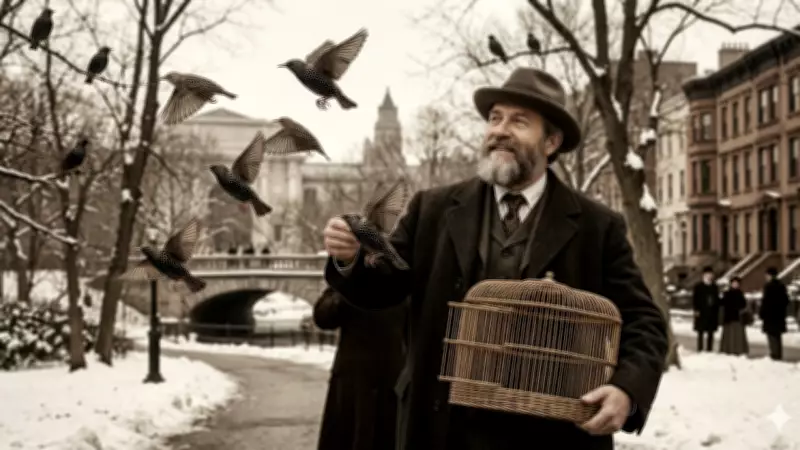
On a spring day in 1890, a small flock of birds took flight over New York City's Central Park. There was nothing particularly remarkable about them at the time. No one watching could have guessed that those few birds would eventually give rise to one of the largest avian populations on the continent.
The Man Behind the Release
The man who released them was not a scientist trying to reshape an ecosystem. He was a literature enthusiast with an unusual ambition. Eugene Schieffelin wanted North America to be home to every bird mentioned in the works of William Shakespeare. To help turn that vision into reality, he released around 100 European starlings into Central Park over two years.
According to the Duke University Press, Schieffelin was a wealthy New Yorker and a member of the American Acclimatization Society, a group that believed introducing foreign plants and animals could enrich the country's environment. At the time, the idea did not seem particularly controversial. Across the world, people were moving species from one continent to another with little understanding of the ecological consequences. Schieffelin's fascination with Shakespeare simply gave him a unique goal.

One of the birds mentioned in Henry IV, Part 1 was the European starling (Sturnus vulgaris). In 1890 and again in 1891, Schieffelin released starlings in Central Park, hoping they would establish a population in their new home.
From 100 to 200 Million
Many introduced species failed to survive. The starling, however, had other plans. Within a few decades, the birds had spread beyond New York. They moved across fields, towns and forests, adapting with remarkable ease to almost every environment they encountered.
As per the National Invasive Species Information Center, unlike some species that rely on very specific habitats, starlings are flexible. They nest in cavities, reproduce quickly and adjust well to human-altered environments. As North America expanded through agriculture and urban development, the birds found countless new places to live.
Their aggressive nature also gave them an advantage. Starlings often compete fiercely for nesting spaces, pushing out native birds such as bluebirds and purple martins. Combined with abundant food sources and few natural obstacles, this allowed their numbers to grow at an astonishing rate.
Today, they are among the most widespread birds on the continent, with populations estimated at more than 200 million.
The Downside of Success
To many people, starlings are beautiful birds. Their feathers shimmer with green and purple iridescence in sunlight, and their vast flocks create breathtaking aerial displays known as murmurations.
Yet their success has come at a cost. Because they are not native to North America, starlings are considered an invasive species. Wildlife researchers have documented their impact on native birds, particularly species that depend on tree cavities for nesting.
Large flocks can also create problems for farmers by consuming crops, livestock feed and fruit. According to the United States Department of Agriculture, starling-related damage costs millions of dollars each year.
For ecologists, the bird has become a textbook example of how introduced species can alter ecosystems in ways that are difficult to predict.
A Lesson Hidden in a Literary Dream
What makes the starling story endure is its unlikely beginning. There was no grand environmental plan. No scientific experiment. Just one man's admiration for Shakespeare and a belief that importing a handful of birds could enrich the American landscape. Instead, those 100 starlings became 200 million.
More than a century later, their descendants remain a living reminder that even the smallest actions can have consequences far beyond what anyone imagines. Few people remember the moment those birds first flew into the skies above Central Park. Yet the impact of that decision still echoes across an entire continent.