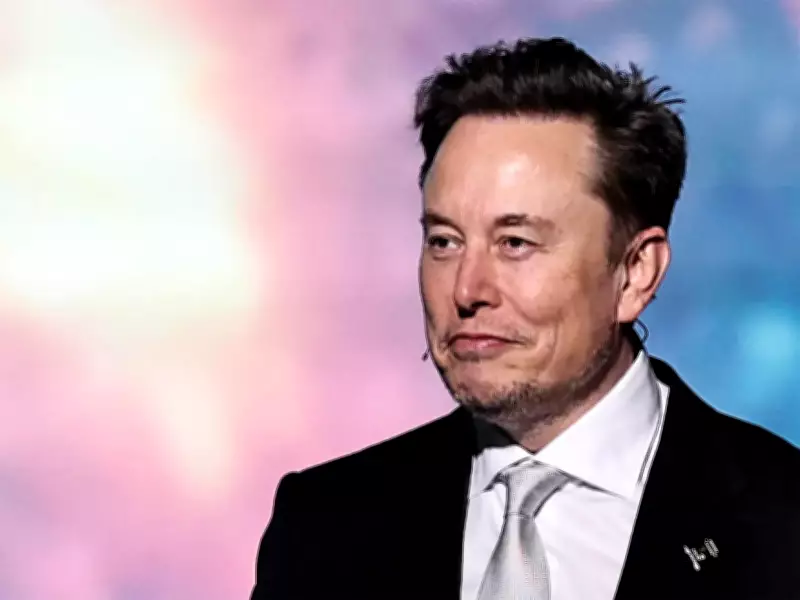
The world may soon witness its first trillionaire. Elon Musk, currently the richest person on Earth, is approaching this unprecedented milestone as SpaceX prepares for an initial public offering (IPO). This IPO is anticipated to be the largest stock market debut in Wall Street history.
SpaceX IPO Details
On Wednesday, the rocket and satellite company revealed plans to list under the ticker symbol SPCX, offering investors a rare look into the finances, leadership, and ambitions of one of the most secretive private companies globally.
SpaceX has valued itself at $1.25 trillion, a figure that could elevate the value of Musk's majority stake to over $600 billion, according to the BBC. Combined with his existing wealth, this listing could potentially push his total net worth beyond the $1 trillion mark. Musk had already become the first person to cross a net worth of $500 billion last year. He also serves as the chief executive of electric vehicle company Tesla and controls 85.1% of SpaceX's voting power through common shares and Class B shares with enhanced voting rights.

Leadership and Ownership Structure
The IPO filing disclosed details of SpaceX's leadership and ownership structure for the first time. Musk serves as chairman, while President and Chief Operating Officer Gwynne Shotwell is also on the board. Other directors include Chief Financial Officer Bret Johnsen, venture capitalists Randy Glein, Steve Jurvetson, Luke Nosek, and Ira Ehrenpreis, private equity executive Antonio Gracias, and Google executive Donald Harrison.
Musk's Mars Mission Compensation
Since 2019, Musk has received an annual salary of $54,080. However, SpaceX stated that he could receive 15 tranches of 66,666,665 shares if the company reaches stock market valuation milestones in $500 billion increments up to $7.5 trillion and successfully establishes a permanent human colony on Mars with at least one million inhabitants. The shares would only be awarded if both conditions are met and Musk remains employed at the company.
Following the merger with xAI earlier this year, SpaceX also replaced Musk's previous compensation arrangement from the AI business with another award of 302 million shares tied to future valuation targets and the launch of data centres capable of delivering 100 terawatts of computing power annually.
SpaceX's Expansion and Vision
Founded by Musk in 2002 as a rocket company, SpaceX expanded into telecommunications in 2021 with the launch of Starlink, its satellite internet service. In its 277-page prospectus, SpaceX outlined an expansive long-term vision centred on artificial intelligence, satellite connectivity, and space exploration. The company stated its mission is "to build the systems and technologies necessary to make life multiplanetary, to understand the true nature of the universe, and to extend the light of consciousness to the stars."
SpaceX plans to continue rapidly manufacturing and launching satellites for its Starlink communications network while also aiming to "harness the Sun to power a truth-seeking artificial intelligence that advances scientific discovery, and ultimately to build a base on the Moon and cities on other planets."
Market Opportunity and Financials
The company told investors it sees a potential market opportunity worth $28.5 trillion, which it described as "the largest actionable total addressable market in human history." This includes $370 billion in space-enabled solutions, $1.6 trillion in connectivity services through Starlink satellites, and $26.5 trillion in artificial intelligence opportunities. Within the AI business, SpaceX projected a $2.4 trillion opportunity from launching data centres into space, $760 billion in potential consumer subscriptions, $600 billion in digital advertising, and $22.7 trillion in enterprise applications.
Financial Portfolio
Space Exploration Technologies, the company's official name, generated $18.6 billion in revenue last year while posting a net loss of $4.9 billion. In the first three months of this year alone, SpaceX recorded $4.7 billion in sales but reported another net loss of $4.3 billion, according to CNN. The company's balance sheet showed it holds $102 billion in assets, including rockets and other equipment, while carrying debt worth $60.5 billion.

SpaceX's expenses have risen sharply as it expands its artificial intelligence and satellite operations. The company spent $20.7 billion last year, with $12.7 billion going towards artificial intelligence infrastructure. Another $4.2 billion was spent on Starlink and $3.8 billion on rockets and other space ventures. That figure was almost double the $11.2 billion spent in 2024 and far higher than the $4.4 billion recorded in 2023. In the first quarter of this year, SpaceX had already spent $10.1 billion, including $7.7 billion on AI-related projects.