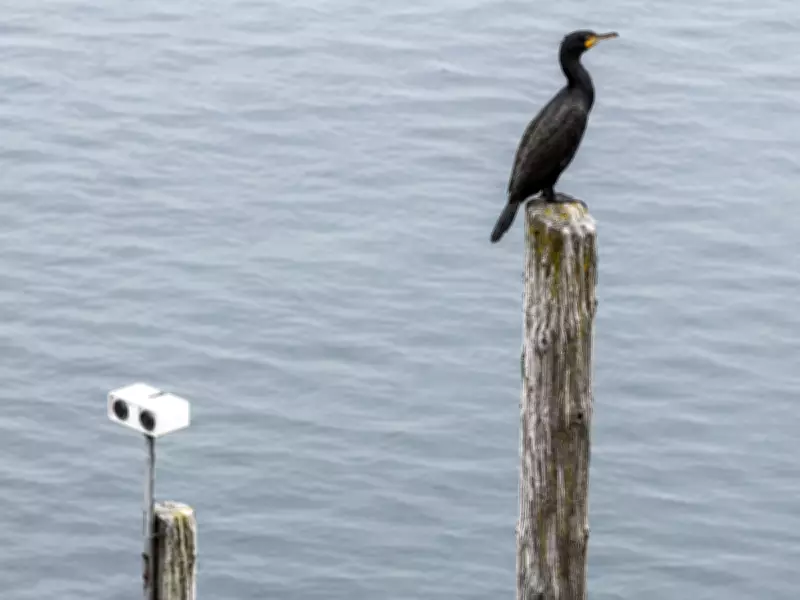
Fishermen in the Western Baltic have long struggled with a feathered dilemma. Great cormorants and gulls have transformed traditional pound nets—large stationary traps used to catch migrating fish—into personal buffets. This is a win for the birds but a nightmare for the local fishing industry. Beyond financial losses, the situation is dangerous for the animals, which often become entangled in the mesh or face the wrath of frustrated fishermen.
The struggle to balance protecting livelihoods and conserving wildlife led a team of researchers to try something unconventional: tricking the birds psychologically. They hoped that placing floating windmills with giant, staring eyes could simulate the approach of a predator. The idea was simple: if the birds thought something was after them, they would stay away from the nets.
High-Stakes Game of Peek-a-Boo
The device, formally known as the Looming-Eye Buoy (LEB), is essentially a small windmill attached to a buoy. On each wing of the windmill are sketches of eyes in different sizes. As the wind catches the blades, they spin fast, creating a looming effect. The varying eye sizes give the impression of a predator closing in rapidly, triggering a natural flight response that sends the birds scurrying for safer waters.

The researchers deployed these spooky peepers in a study titled Looming-Eye Buoys temporarily reduce the number of piscivorous seabirds around fish traps, published in the journal Royal Society Open Science. The initial results were triumphant. Just four days after the LEBs were placed in the water, sites with the googly-eyed guardians had almost four times fewer birds than control sites without devices. For a moment, it seemed that the valuable catch of herring and mackerel could be protected by a low-tech, harmless solution.
Previous efforts to solve the problem often backfired. Some fishers tried covering traps with extra netting, but cormorants proved to be Olympic-level swimmers, diving deeper and entering traps from below. Other efforts included constructing small hiding chambers in the nets for fish, which kept fish safe but created a new tragedy: birds became trapped in these smaller spaces and drowned. The LEB was supposed to be the humane option that kept everyone—fish, birds, and humans—safe and happy.
When the Scare Factor Wears Off
But nature is rarely so easily fooled for long. As the weeks passed, the spinning eyes began to lose their effect. On the 46th day of the trial, researchers observed a frustrating trend: the fear factor had vanished. The birds, including clever herring gulls and greater black-backed gulls, had worked out that these staring eyes were all bark and no bite.
The study showed that bird populations fully habituated to the device about one month after implementation. The terrible predator they once feared turned out to be a harmless, spinning toy. The difference in bird numbers between protected nets and regular nets became insignificant. The birds had called the researchers' bluff and returned to their perches on the wooden poles of the pound nets, waiting for their next easy meal.
This habituation phenomenon is a major hurdle in wildlife management. Animals, especially highly intelligent seabirds, are adept at assessing real risks versus false alarms. The Looming-Eye Buoy offers a beacon of hope but also serves as a reminder that the battle between human industry and animal instinct is a constant cat-and-mouse game—or, in this case, a gull-and-buoy game. For now, the search continues for a way to keep the dinner plate safe without losing the scare in the scarecrow.