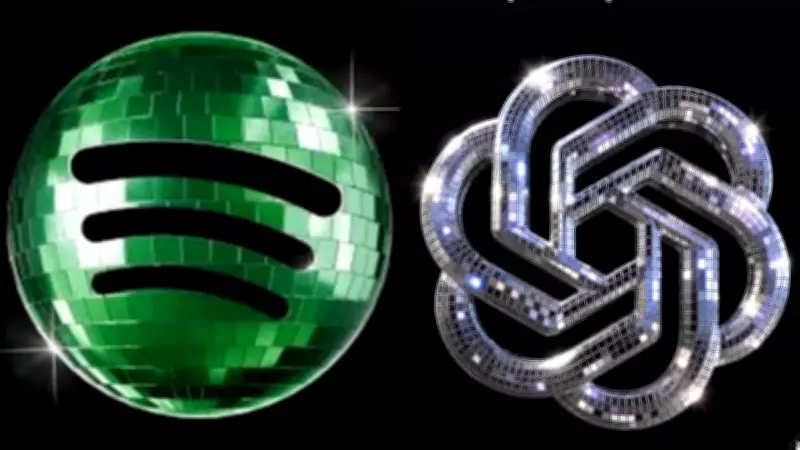
On 14 May 2026, Spotify changed its app icon to a sparkly green 3D disco ball to celebrate its 20th anniversary. The internet immediately split in two. Some users loved the nostalgic party aesthetic, while others called it 'pixelated garbage'. Four days later, Spotify backed down and confirmed the classic icon would return. That should have been the end of the story. Instead, it became the beginning of one of the strangest design trends of 2026.
The Birth of a Trend
Within days, ChatGPT posted a mirror-ball version of its own logo on Instagram. OpenAI's official account replied in the comments: 'Everyone is going to love this.' The post collected more than 180,000 likes in two days. Then other companies joined in. Notion did it. MoonPay did it. Uniswap did it. Appwrite hinted at doing the same. Soon, someone built an app called Discomorphism that could transform almost any logo into a disco-ball version within seconds. What started as backlash against Spotify's temporary icon quickly evolved into a viral internet-wide branding trend built entirely around mirror tiles, nostalgia, and playful chaos.
What Spotify Actually Changed
Spotify's anniversary campaign, titled Spotify 20: Your Party of the Year, focused heavily on nostalgia. Users could revisit their listening history, discover their first streamed song, and see their all-time favourite artists. The disco-ball app icon was designed as the visual centrepiece of that celebration. The temporary redesign kept Spotify's signature soundwave lines but wrapped them inside a glittering green sphere with texture, reflections, and retro styling meant to resemble a party disco ball. Most users, however, never saw the explanation. They simply opened their phones and noticed that one of the world's most recognisable app icons suddenly looked completely different.

Social media reacted almost instantly. Users described the icon as 'cheap', 'AI-generated', and 'hideous'. Some even believed their app was stuck updating or had downloaded incorrectly. One viral X post joked that the icon looked like it was 'constantly updating'. Spotify responded with a deliberately light tone. On 17 May, the company posted: 'Alright, we know glitter is not for everyone. Our temp glow up ends soon. Your regularly scheduled Spotify icon returns next week.' The old icon is returning, but by then the internet had already turned the redesign into something much larger.
ChatGPT Turned the Backlash into a Trend
The turning point came when ChatGPT joined the conversation. The verified ChatGPT Instagram account uploaded a disco-ball version of its logo, transforming its familiar geometric swirl into reflective mirror tiles. The caption simply asked: 'What do you guys think?' OpenAI's official account replied: 'Everyone is going to love this.' The interaction immediately amplified the trend, pushing it beyond Spotify's anniversary campaign and into mainstream internet culture. The moment mattered because it reframed the disco-ball aesthetic from an unwanted redesign into a shared joke that brands and users could participate in together.
There was also an ironic layer to the moment. In late 2025, ChatGPT had already drawn comparisons to Spotify after launching 'Your Year with ChatGPT', a personalised year-end recap inspired by Spotify Wrapped. Now OpenAI appeared to be following Spotify again, this time visually rather than structurally. Once ChatGPT embraced the trend, other companies moved quickly. Notion posted its own disco-inspired design. MoonPay compared 'balloonmorphism vs. discomorphism'. Uniswap joked in the comments section. Appwrite hinted it might join too. The trend was no longer about one app icon. It had become a collaborative internet meme.

The Internet Even Invented a Name for It
Somewhere in the flood of memes and redesigns, a new term appeared: discomorphism. The word combines 'disco' with 'skeuomorphism', the old design philosophy that made digital interfaces resemble physical objects. Early smartphone apps often copied real-world textures and materials: notepads looked like paper, bookshelves looked wooden, and buttons appeared tactile. Discomorphism takes that idea to an exaggerated extreme. Logos are coated in reflective mirror tiles, lit dramatically, and transformed into glittering 3D objects. The term quickly spread online. A post from @RaceJohnson describing the aesthetic gained nearly 2 million views. Designers and brands started using the word as shorthand for the style.
A tool called Discomorphism was then built using Lovable to automate the effect. Users could upload a logo and instantly generate a disco-ball version for social media or branding experiments. Designer Szymon, posting as @aecyydesign on X, even shared a detailed workflow using ChatGPT's image generation tool. The process involved uploading Spotify's disco icon as a reference image alongside a logo and prompting the AI to preserve the exact geometry while replacing the material with reflective mirror tiles. The result was a trend partly powered by AI tools and simultaneously promoted by the companies building those tools.
Why This Trend Exploded in 2026
The rise of discomorphism reflects a broader shift happening across digital design. For more than a decade, app and logo design was dominated by flat minimalism: clean lines, simple colours, geometric icons, and stripped-down branding. By 2026, many designers and users had grown tired of that aesthetic. Current design trends are increasingly moving toward texture, dimensionality, asymmetry, nostalgia, and visually expressive interfaces. Spotify's disco-ball icon landed at exactly the right cultural moment.
The timing became even more significant because Apple's new Liquid Glass interface language was also dominating design discussions at the same time. Apple's updated design system introduced translucency, depth, reflections, and more tactile visual elements across iOS. Without directly copying one another, both Spotify and Apple were responding to the same broader sentiment: people wanted screens to feel expressive again. Discomorphism became the internet's meme-driven version of that movement. It was loud, nostalgic, intentionally impractical, and visually playful in a way modern branding rarely allows itself to be.
What This Says About Brands in 2026
The speed of the trend revealed something important about how internet culture now works. A decade ago, branding campaigns were carefully planned months in advance. Today, the brands that succeed online are often the ones capable of reacting fastest to memes, trends, and cultural moments. Spotify accidentally created a visual trend through backlash. ChatGPT transformed it into participation. Other brands joined before the joke disappeared. The speed was the entire point.
App icons are no longer just software shortcuts. For many users, they are part of personal identity, daily routines, and digital aesthetics. That is why Spotify's redesign triggered such emotional reactions in the first place. When Spotify changed the icon unexpectedly, users felt like something familiar had been altered without permission. When ChatGPT voluntarily turned its own logo into a disco ball, the same aesthetic suddenly became fun rather than intrusive. The difference was participation.
Spotify's glittering icon will soon disappear. The classic green circle will return. But the strange week that produced the backlash, the memes, the ChatGPT post, the viral tweets, and an entire mirror-tile design movement may end up being remembered as one of the defining internet branding moments of 2026.