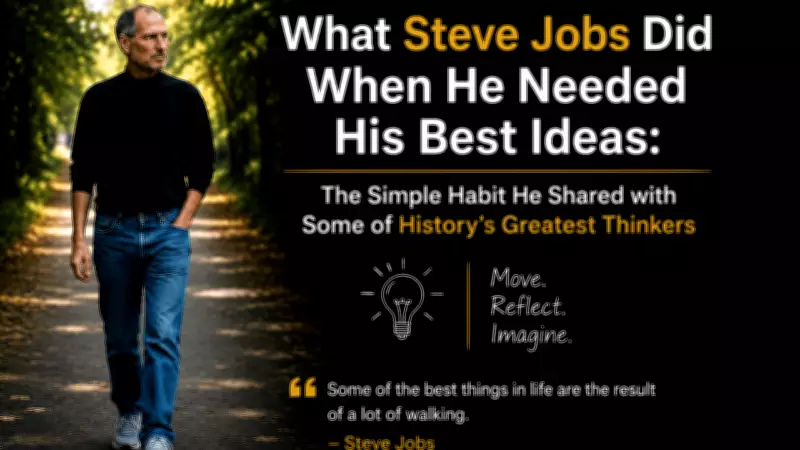
When Walter Isaacson arrived to interview Steve Jobs for a potential biography, he expected a conventional conversation. Instead, Jobs proposed a walk. 'I didn't yet know that taking a long walk was his preferred way to have a serious conversation,' Isaacson later wrote. That walk led to Jobs offering Isaacson the opportunity to write his biography, a pivotal decision made not in a boardroom but while the two were simply moving.
A Timeless Habit of Great Thinkers
Jobs was not alone in this practice. Throughout history, brilliant minds have followed the same pattern. Aristotle instructed his students while walking, and Charles Darwin had a specific path installed for daily thinking. Mark Zuckerberg and Twitter co-founder Jack Dorsey also embraced walking meetings. LinkedIn CEO Jeff Weiner adopted the same habit. This was not a trendy productivity hack; rather, different minds across centuries and industries independently concluded that walking clarifies thinking. Now, science is finally explaining why.
The 60% Creativity Boost
Stanford University researchers conducted a study with 176 college students who completed creative tasks while sitting and then while walking. In one experiment, participants were given sets of three objects and asked to generate alternative uses. The results were striking: walking boosted creative thinking by an average of 60%. Interestingly, the creative boost persisted shortly after sitting back down, meaning a brief walk before a meeting can be effective. However, the researchers also found that sitting is better for problems with a single correct answer. For instance, participants sitting were better at finding the word that combines 'cottage, Swiss, and cake'—the answer being 'cheese.' So walking excels for divergent thinking but not for focused problem-solving.

Neuroscience Behind Walking and Creativity
The neuroscience is elegant. Walking requires minimal conscious effort, allowing attention to wander freely. This mental state is linked to innovative ideas and insights. When sitting at a desk, hyper-focus on a problem can hinder breakthroughs, which often occur when the mind is engaged in something else. Walking breaks the grip of hyper-focus, letting imagination run in the background. Jobs intuitively understood this, using a '10-minute rule': when facing a challenging problem, he would take a walk to refresh his mind. Ten minutes was enough for his brain to shift gears.
Walking Culture at Apple
On the Apple campus, walking was not solitary. Jobs and chief designer Jony Ive regularly took brainstorming walks. Pixar employees noted that Jobs 'was always big on going for walks with people.' This was his actual working method. The iPhone was conceived not in a conference room but during walks with Ive. Other tech leaders followed suit. Jack Dorsey told Fortune that he prefers outdoor walks, stating, 'If I'm with a friend we have our best conversations while walking.' Movement fosters deeper, more honest conversations, and walking side by side eliminates hierarchy, unlike sitting around a table.
An Ancient Practice Validated by Modern Science
It is remarkable that Stanford researchers and neuroscience confirm what Aristotle knew over two thousand years ago. He founded the Lyceum in Athens, teaching while walking—the Peripatetic school. Darwin, Aristotle, and Jobs all arrived at the same conclusion. Researchers write that 'walking opens up the free flow of ideas.' Intuitively, we know this; it is why showers are often cited as places for ideas. Walking offers the same benefit, with the added advantage of real-time collaboration. The next time you are stuck, do not sit longer. Get up, step outside, and you might return with the idea that changes everything.