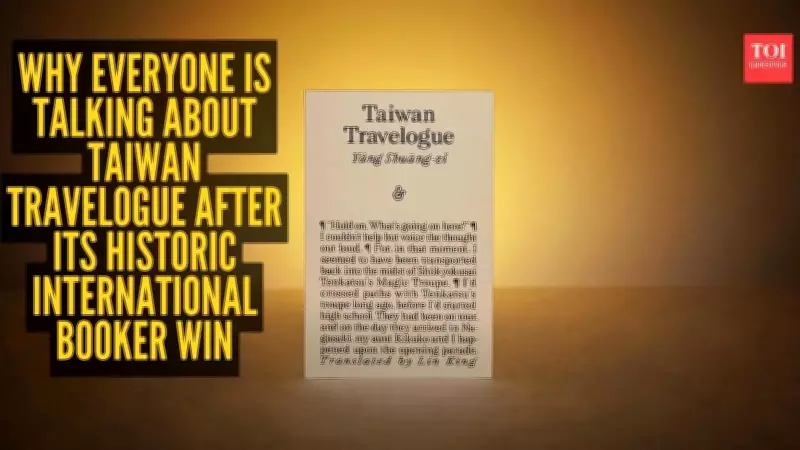
The literary world has a new obsession: Taiwan Travelogue. After winning the International Booker Prize, the novel by Yang Shuang-zi, translated by Lin King, has become one of the most discussed books online. The win is historic: it is the first novel translated from Mandarin Chinese to win the prize, and Yang and King are the first Taiwanese and Taiwanese-American winners. But beyond the headlines, the story itself has captivated readers with its layered exploration of identity, colonialism, romance, language, and memory.
What Is Taiwan Travelogue About?
At first glance, the novel presents itself as a rediscovered Japanese travel memoir from the 1930s. It follows Aoyama Chizuko, a Japanese writer traveling through Taiwan during Japanese colonial rule, accompanied by a Taiwanese interpreter named Chizuru. Together, they share meals, conversations, and train rides, slowly developing feelings for each other. Beneath this simple setup lies emotional complexity: the romance unfolds against an imbalance of power between colonizer and colonized. Booker judge Natasha Brown described it as both a love story and a sharp postcolonial novel.
Exploring Taiwan's Complicated Past
Yang Shuang-zi wanted to explore how Taiwan remembers Japanese colonial rule differently from other countries. Unlike Korea's straightforward anger, Taiwan's historical memory is conflicted, blending pain with nostalgia and cultural overlap. This tension became the emotional backbone of the novel, showing how ordinary people navigated identity, survival, and desire under colonial systems. The novel feels modern despite its 1938 setting, acknowledging that history is messy and people are contradictory.

Translator Lin King's Approach
Lin King has become a key part of the conversation, openly discussing her approach to historical fiction. She dislikes stories that reduce characters to suffering; even during dark periods, people flirted, laughed, and fell in love. This philosophy shapes Taiwan Travelogue, which leaves room for pleasure, humor, and intimacy. The emotional richness is why readers are connecting so intensely.
The Food Descriptions Are Incredible
Readers rave about the food descriptions: braised pork rice, winter melon tea, regional dishes, train snacks. Meals become central emotional moments, discussing class, identity, colonial influence, and memory. Yang joked that researching the book caused her to lose money and gain weight, a fan-favorite quote that captures the novel's sensory world.
The Translation Earns Praise
Lin King's translation preserves the novel's layered structure, including fake footnotes, introductions, and metafictional commentary. Critics say she kept the book elegant and immersive. King described the process as intentionally maximalist, avoiding oversimplification for English readers. This choice has paid off, making the translation nearly as praised as the novel itself.
Why This Win Feels Bigger
The excitement around Taiwan Travelogue also stems from its cultural significance. Taiwanese literature rarely gets global visibility, and for a Mandarin Chinese novel to win a top prize feels significant. Readers see it as discovering a literary tradition that hasn't received mainstream attention. The book arrives at a time when readers are interested in stories about identity, migration, and cultural memory, while remaining deeply emotional and character-driven.
At Its Core, a Love Story
Despite the political analysis, what stays with readers is the relationship between Chizuko and Chizuru. Their connection is tender, awkward, and shaped by unsaid things. The central question—can genuine love exist inside unequal systems of power?—is left ambiguous. This emotional honesty is why the novel lingers in minds long after reading.