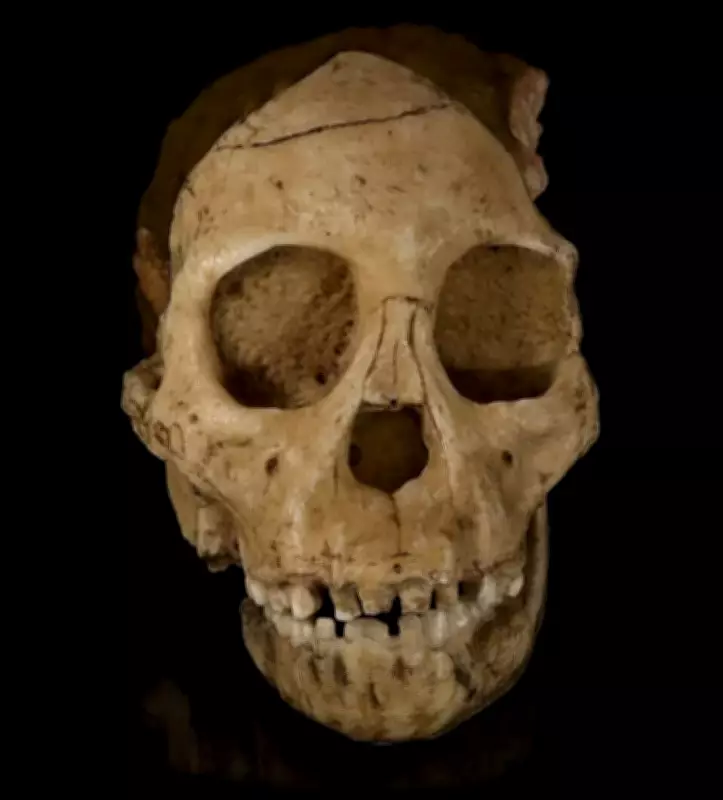
Picture yourself at work in a quarried pit where limestone was mined using dynamite charges, only to find that after the smoke clears, there lies before you the face of a small child. This was the reality at Buxton Limeworks near Taung, South Africa, in the fall of 1924. A gang of local quarrymen was blasting a cave deposit to extract lime for industrial purposes, but they unearthed something extraordinary. Instead of a standard fragment of limestone, the workers noticed a beautifully preserved skull that retained the distinct shape of a brain and a full set of small teeth.
The quarry workers had no idea that their blasting activities had just provided the perfect catalyst for the biggest revolution in evolutionary science. Eventually, the remains ended up on the desk of a young anatomist named Raymond Dart. Upon peeling back the outer rocky layers covering the skull, he examined an appearance that seemed to be a mixture of both ape and human features. Realizing that he was in possession of a vital component to a large prehistoric jigsaw puzzle, he changed the entire course of our understanding of human prehistory forever.
Challenging a Well-Established Scientific Theory
The sudden discovery of this small skull caused a significant clash within the international scientific community, as it directly contradicted the prevailing ideas of the day about where our ancient ancestors originally evolved. According to a historical account archived at the Smithsonian Institution Human Origins Program website titled "Taung Child," Raymond Dart formally named this species Australopithecus africanus in early 1925. He confidently declared that this tiny creature was a bipedal ancestor that walked upright on two legs, representing the true evolutionary link between apes and humans.

Throughout the 1920s, the conventional scientific community believed that the origin of mankind would emerge in Europe or Asia, based on fraudulent or misrepresented findings from those continents. In an extensive evolutionary review featured in National Geographic, several notable European scientists strongly opposed Dart's theory for almost two decades. They considered the fossil nothing more than an ancient baboon or a regular ape, unable to accept that the sophisticated roots of human ancestry began in the heart of Africa.
Establishing Africa as the True Cradle of Humanity
The real value of the Taung Child lies in the subsequent years, as further evidence emerged in support of this discovery. With an increasing number of scientists venturing into Africa, several other adult specimens of the same species surfaced in adjacent caves, validating Dart's initial hypothesis. As shown by the fragile skull, it appears that our ancestors had already mastered bipedal locomotion before evolving a relatively large brain.
Today, the celebrated fossil is regarded as one of the world's priceless treasures and a major landmark in the development of evolutionary science. The significance of the 1924 findings is an eloquent testimony to how our interpretation of the past continually changes. This demonstrates that the most revolutionary discoveries do not necessarily come from carefully designed academic projects or well-financed educational institutions. Instead, it may take a fortuitous explosion in a stone quarry and the fragile remains of a face that is 2.8 million years old to dispel a comforting myth.
It is mindboggling and humbling to realize that while earlier researchers of the twentieth century spent decades investigating the origins of man on other continents, our true history lay in silence within a limestone formation in South Africa.