Peter Thiel's Secret Rome Lecture: AI Regulation as Pathway to Antichrist
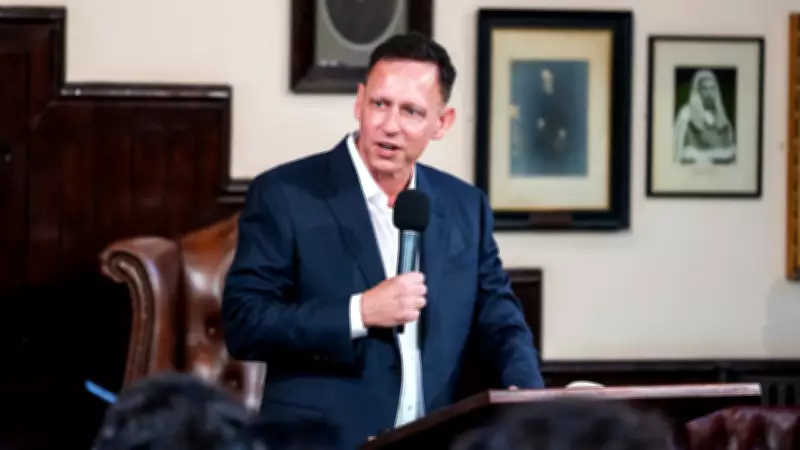
In a secret location in Rome this week, under conditions of strict confidentiality, Peter Thiel delivered a controversial lecture that has sent shockwaves through Catholic intellectual circles. The PayPal co-founder, Palantir architect, and influential political donor stood before a carefully selected audience of academics, technologists, and conservative Catholics to present his radical interpretation of the Antichrist as a contemporary threat.
The Undisclosed Gathering
The venue remained undisclosed, the guest list was sealed, and all recording devices were prohibited. This clandestine atmosphere surrounded Thiel's presentation, which argued that the Antichrist represents not merely a historical curiosity or metaphorical concept, but a live and present danger manifesting through respectable modern institutions.
"The Antichrist will not arrive as a tyrant. He will arrive as the most reasonable person in the room," Thiel reportedly told his audience, framing global governance structures, AI safety regulation, and environmental caution as potential pathways to authoritarian control.

Reinterpreting Two Millennia of Theology
To understand why Thiel's lectures have detonated within Catholic intellectual circles, one must examine the historical evolution of the Antichrist concept across two thousand years of Christian theology. The term appears in four places in the Bible, all within the letters of John written around 90 AD. Notably, it never appears in the Book of Revelation, despite popular association with apocalyptic imagery.
In John's original Greek, antichristos carries dual meaning: both against Christ and in place of Christ, representing an impostor rather than merely an enemy. John wrote in the plural and present tense, stating "many antichrists have already come" rather than predicting a singular future figure.
Over centuries, the concept evolved significantly. Medieval Catholic theology developed the idea of a singular charismatic deceiver who would appear near history's end, performing false miracles and demanding universal worship. The Protestant Reformation weaponized this concept further, with Martin Luther declaring the Pope himself to be the Antichrist, a charge that permanently fractured Western Christendom.
The Girardian Foundation
Central to Thiel's argument is the philosophy of René Girard, the French-American thinker who spent his career at Stanford developing the theory of mimetic desire. Girard argued that people want things not independently but through imitation, wanting what others want. Societies manage the resulting violence through scapegoating mechanisms, where communities select victims to bear collective guilt and restore peace through their destruction.
Girard maintained that the Gospels uniquely expose this mechanism, with Christ becoming the innocent scapegoat whose Resurrection reveals the mob's lie. Thiel has absorbed Girard's thinking deeply and extended it into territory Girard rarely explored: technology, geopolitics, and existential risk.
The Reasonable Apocalypse
Thiel's central theological innovation represents what many critics acknowledge as intellectually original. The traditional Antichrist appears monstrous—a tyrant, blasphemer, and conqueror whom the faithful would recognize as an enemy. Thiel's version looks dramatically different.
"He will not look like a villain. He will look like the most qualified person who has ever held power," Thiel argued. In this framework, the Antichrist arrives not through conquest but through competence, not feared but trusted, with power handed to him because the world's problems appear frightening and real.
This figure becomes the bureaucrat with the perfect plan, the technocrat with impeccable credentials, the statesman speaking calmly about responsibility and safety—the adult in the room. The rise of this Antichrist depends not on violence but on consensus, as the world faces existential threats and seeks solutions through global authority.

Mapping Modern Debates
Thiel's framework maps directly onto contemporary political debates. The AI safety researcher calling for international governance of artificial intelligence, the climate scientist advocating global enforcement mechanisms, the biosecurity expert proposing powerful international health authorities—each represents rational, well-intentioned proposals that, in Thiel's interpretation, create architecture for global authority.
This explains Thiel's controversial description of Greta Thunberg as a "legionnaire of the Antichrist." In his framework, she represents not malice but sincerity—a passionate advocate for solutions that centralize power in response to global fear. The same logic extends to nuclear non-proliferation treaties, international financial regulation, and digital platform governance, each involving calls for coordination that could contribute to systems capable of controlling humanity's future.
The Accelerationist Response
Thiel's counter-strategy is acceleration. If the Antichrist emerges through power consolidation, the response must be decentralization. Technological development must advance rapidly enough that no single authority can control it.
This philosophy runs through Thiel's investments and political worldview. Decentralized technologies like Bitcoin reduce reliance on central authorities. Defense technology startups distribute military capability among nation-states. Space exploration opens possibilities for humanity existing across multiple planets, creating a civilization that cannot easily be governed by single authority.
The result accepts certain geopolitical disorder as preferable to unified global government. A world of competing states may be unstable, but it prevents the emergence of consolidated power structures Thiel identifies as dangerous.
Challenging Vatican Authority
The lecture location added significant symbolic weight. Pope Leo XIV has repeatedly called for stronger AI regulation, defended international institutions, and emphasized moral responsibilities guiding technological development. In Thiel's framework, such calls for coordinated oversight resemble the very structures he warns could enable the Antichrist's rise.
The Vatican-aligned newspaper Avvenire criticized Thiel's ideas as promoting what it described as a "superplutocracy"—a system where powerful technology elites claim authority over humanity's future. The paper argued that in attempting to protect humanity from the threat he associates with the Antichrist, Thiel ultimately proposes technological solutions risking limitation of "what is most human in humanity."
Avvenire also highlighted Thiel's criticism of "woke" cultural attitudes, particularly his rejection of political movements prioritizing protection of vulnerable groups. According to the newspaper, this rhetoric reflects a worldview where defense of the weak is dismissed as ideological weakness, while technological acceleration and innovator authority are elevated above democratic oversight.
Theological Geopolitics
Massimo Faggioli of Trinity College Dublin described the lectures as part of broader attempts to create an alternative American intellectual presence in Rome, challenging the Vatican's moral and political framing of technology, global governance, and social responsibility.
Reports suggest Thiel has privately worried about JD Vance growing too close to the Pope, reflecting deeper debates over whose vision of Christian civilization should shape Western politics. The significance of Thiel's lectures lies not only in their theology but in their political ambition—attempting to provide an intellectual framework linking technological acceleration, American geopolitical power, and particular Christian interpretation.
In this narrative, technological freedom becomes resistance against tyranny. The Catholic Church has navigated competing political powers for two millennia and recognizes emerging rival authority centers. Thiel's project suggests one such alternative vision, where the cautious become obstacles, technological disruptors become freedom defenders, and the Antichrist may appear as the person urging humanity to slow down.
Whether one agrees with his conclusions or not, Thiel's argument is shaping influential debates about technology, power, and global governance's future, creating theological frameworks with direct geopolitical implications in an increasingly complex world.