

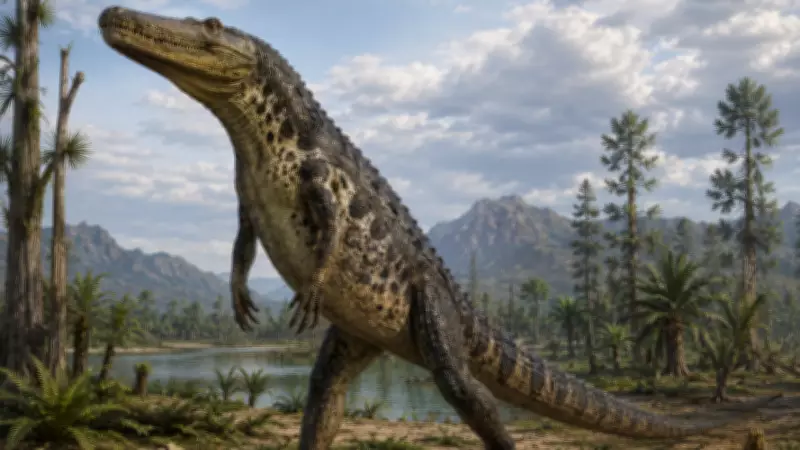
A newly identified relative of the crocodile lineage has turned out to be strikingly different from its modern counterparts. Labrujasuchus expectatus, which lived 212 million years ago in what is now New Mexico, was bipedal, toothless, and had a beak. This creature challenges the typical image of crocodiles as armoured, low-slung, and toothy predators.
Discovery of Labrujasuchus expectatus
The remains of L. expectatus were originally excavated in 2006 from a quarry at Ghost Ranch in New Mexico, a site renowned for its rich trove of Triassic-era fossils. The bones sat in collections for years before researchers took a closer look and realized something was different. The specimen closely resembled the two recognized North American species of Shuvosauridae, a family of ancient bipedal reptiles, but was not quite either of them. The bones were dated to around 212 million years ago, placing them between the two known North American Shuvosauridae species in time. Subtle but consistent physiological differences, including in the shape of the humerus, distinguished the specimen from its closest relatives.
Physical Features and Bipedal Movement
Labrujasuchus expectatus walked exclusively on its two hind legs, with small forelimbs that were largely vestigial in function. This makes it deeply counterintuitive as a crocodile relative, as every living crocodilian moves on four legs, pressing itself close to the ground. L. expectatus stood upright, in a posture more reminiscent of a small theropod dinosaur. It also had no teeth; instead, it had a beak similar to that seen in birds today. This raises questions about its diet. While the absence of teeth does not necessarily indicate herbivory, Alan Turner, professor of anatomical sciences at Stony Brook University and leader of the discovery team, believes L. expectatus was most likely a meat eater and possibly a scavenger. Flowering plants had not yet evolved 212 million years ago, so fruit was not available.

Relationship to Modern Crocodiles
Turner is explicit that this animal is definitely not a direct ancestor to modern alligators and crocodiles. The relationship is better understood as an extremely distant branch of the same broader family tree. The Shuvosauridae family to which L. expectatus belongs sat within Archosauria, the same group that includes both crocodilians and dinosaurs. However, the Shuvosauridae lineage was its own experiment: bipedal, beaked, toothless, apparently carnivorous, and ultimately extinct. It did not survive into the Jurassic, while the crocodile line, which took the opposite approach, is still with us today.
Insights into Convergent Evolution
Labrujasuchus expectatus adds a significant data point to the science of convergent evolution, the process by which unrelated or distantly related animals independently evolve similar traits. L. expectatus was not a dinosaur, nor even closely related to them, yet it walked like one, was roughly the same size as many small theropods of the same period, and almost certainly occupied a similar ecological niche. The resemblance was not inherited but arrived at independently through a completely separate evolutionary lineage responding to similar environmental conditions. Turner notes, "It's one more data point that we have in furthering these models about that important evolutionary process." Convergent evolution suggests that certain designs, such as bipedalism and beaks, are optimal responses to particular conditions, not random accidents.






