Treehoppers, small plant-eating insects from the Membracidae family, are gaining interest among scientists due to their unique vocalizations and extremely weird-looking bodies. These insects inhabit various forested areas and tropical ecosystems worldwide, but what sets them apart is the sound of vibrations they emit. Some scientists have described these sounds as similar to those of dinosaurs, cows, and other animals. Researchers who study insect communication, vibrational signaling, and rainforest diversity believe that these vibratory sounds help treehoppers warn their peers about danger, find a mate, and communicate with their offspring.
How Rainforest Treehoppers Create Strange Animal-Like Sounds
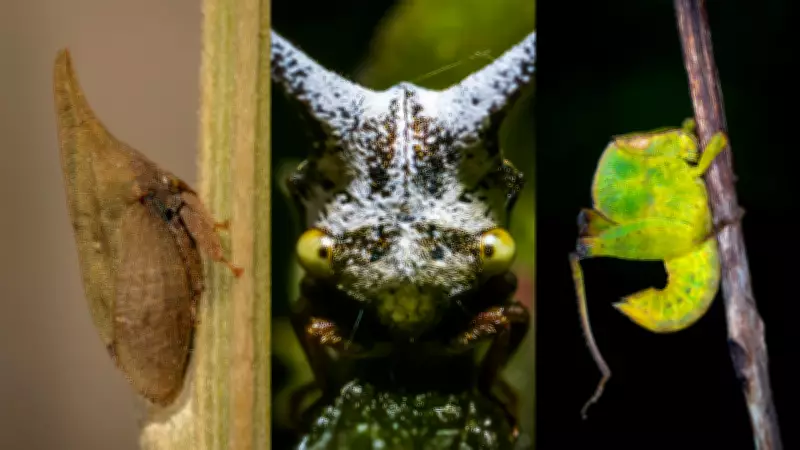
Initially, one might think treehoppers are innocuous. They come in various sizes, but most are small, less than one centimeter in length, with bizarre-looking helmets resembling thorns, leaves, and spikes. What makes these creatures unique is that scientists have discovered that treehoppers send signals to each other using very complicated vibrational sounds. Unlike crickets and cicadas, treehoppers do not produce sounds that can be heard from afar. Their communication relies on generating vibrations in the stem or leaf of a plant using special muscles in their abdomen. These vibrations travel along the plant and are detected by other treehoppers using receptors in their legs.
According to researchers from the California Academy of Sciences, some vibrations from treehoppers can even sound similar to growls, buzzing motors, and animal sounds after being translated into audible signals for humans. The findings made by Jeremy S. Gibson and Reginald B. Cocroft of the University of Missouri, Columbia, were reported in the study 'Vibration-guided mate searching in treehoppers: directional accuracy and sampling strategies in a complex sensory environment,' which noted that treehoppers communicate via substrate-borne vibrations that travel through trees.

Mini Marvels of the Rainforest: Why Scientists Compare Treehopper Sounds to Dinosaurs and Cows
The comparison to dinosaurs and cows largely stems from the way researchers process treehopper vibrations into sounds humans can hear. Many of these amplified recordings produce deep, pulsing noises that resemble growls, moos, or rumbling calls. The study also suggested that treehopper mothers and offspring communicate constantly through vibrational exchanges. Young treehoppers send distress signals when predators attack, while mothers respond by defending them aggressively. Scientists believe these vibrations evolved because they are highly effective in dense vegetation, where visual signals may be limited. Vibrations also allow insects to communicate without attracting as much attention from predators.
Interestingly, some treehopper species display social behavior rarely seen in insects outside ants or bees. Mothers often remain with their young for weeks, guarding eggs and responding to warning vibrations from their offspring.
The Strange Appearance of Tiny Treehoppers
Treehoppers are considered some of the most peculiar insects in the world due to their large pronotum, which looks like horns, spines, mushrooms, or alien sculptures. The National Geographic Society has cited treehoppers as wonderful examples of evolution because of their incredible abilities. They camouflage themselves as thorns or debris to escape from natural enemies such as birds and spiders. There are more than 3,000 treehopper species around the world, especially in the tropical rainforests of South America, Central America, and certain parts of Asia. Scientists continue to discover new species of treehoppers.
Why Treehopper Research Matters in Entomology
The study of treehoppers also helps scientists learn more about insect communication, biodiversity, and the health of the environment. Since treehoppers use plants extensively to communicate, they are vulnerable to changes in their environment, including habitat loss. Experts in bioacoustics also believe that studying vibrational communication may inspire new developments in robotics and sensing technology. However, above all, treehoppers show scientists just how little is known about the hidden communication occurring in forests and grasslands.

Incredibly small, treehoppers are demonstrating that the tiniest creatures of nature have some of the most incredible sounds. With sounds like growling dinosaurs and mooing cows, treehoppers are changing scientists' perception of animal communication in nature.