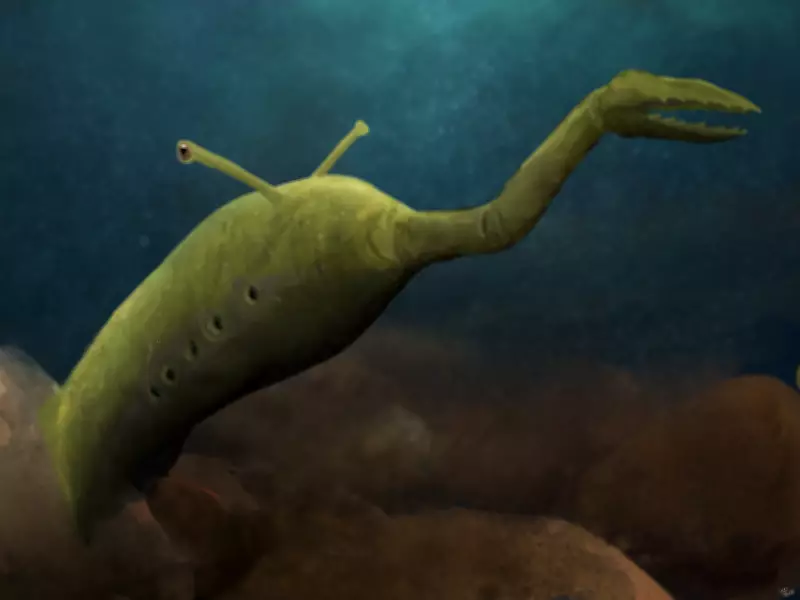
Many of the most perplexing mysteries in scientific history do not originate in outer space or exotic locations like jungle ruins; instead, they are hidden in ordinary-looking rocks found within domestic coal mines. In 1958, a hobbyist pipefitter and fossil hunter named Francis Tully discovered a smooth ironstone nodule. He broke it apart with his hammer, expecting to find a common fern leaf or a tiny shrimp. Instead, he encountered a shape that seemed entirely alien to Earth.
The Discovery of the Tully Monster
The creature preserved in the stone was soft-bodied, completely lacking a shell or bones, and possessed an anatomical structure unlike anything alive today. It had a torpedo-shaped torso, eyes perched on the ends of long, rigid stalks resembling submarine periscopes, and a long, flexible snout ending in a toothy claw. Tully brought his find to local experts, but no one could identify it. So unusual was this beast that it became known simply as the “Tully Monster.” What began as a casual weekend interest quickly evolved into an obsession spanning over five decades, stumping generations of scientists in museum departments worldwide.
A Biological Freak That Refuses Classification
For decades, this strange creature baffled scientists globally, as it seemed to have no place among any known animal species. According to a leading evolutionary biology research paper titled “The ‘Tully monster’ is a vertebrate,” published in the journal Nature, advanced multispectral imaging revealed that the monster had something resembling a notochord—a precursor to a spine. This announcement was expected to resolve the decades-old puzzle, but the Tully Monster refused to be neatly categorized. Shortly after, a counter-study titled “The ‘Tully Monster’ is not a vertebrate,” published in Palaeontology, vigorously disputed these findings. This research argued that the structures inside the fossil were actually tissues from an invertebrate, potentially placing the animal closer to ancient worms, mollusks, or arthropods.

The ongoing and fierce controversy has turned this lone Illinois specimen into a perfect symbol of scientific humility. It demonstrates that despite all advances made possible by sophisticated modern scanning lasers, nature can always surprise us with ancient patterns that defy consensus. Debates rage over whether it was a vertebrate or an invertebrate. Thousands of these fossils have been found, all from the Mazon Creek estuary.
Why a Local Coal Mine Became a Global Time Capsule
It all boils down to the fact that this creature has never been found outside its habitat. As explained in historical records at Chicago’s Field Museum, thousands of fossils of this creature have been unearthed, yet every one of them comes from Illinois soil. The unique composition of sediments that once filled the Mazon Creek estuary preserved soft-bodied animals in stony concretions until today.
In the modern world, this animal is recognized for its oddities to such an extent that it has been declared the state fossil of Illinois. This serves as a reminder for both amateur collectors and casual walkers that great scientific discoveries can happen without spending a fortune traveling to far-off places. Sometimes, all it takes is a sharp mind and keen eyes to make an astounding discovery right in your own backyard.
It is a marvelous thought to ponder how many of these small creatures with periscopic eyes roamed a tropical sea 300 million years ago, completely unaware that their form would one day baffle even today’s scientists.